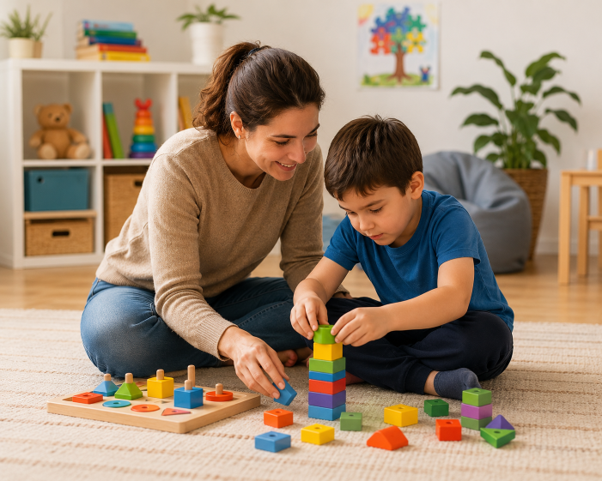
Teacher and two children look excited as they learn letters; the teacher holds a red card with the letter S for a spelling activity

Speech Therapy vs Occupational Therapy for Children

Speech Therapy vs Occupational Therapy

When parents begin researching speech therapy vs occupational therapy for children, confusion is common and completely understandable. Both therapies play a crucial role in child development, yet they address very different challenges.

Speech therapy for kids focuses on communication skills, how a child speaks, understands, and expresses language. In contrast, occupational therapy for children focuses on helping children perform everyday tasks independently, such as writing, dressing, or eating.

Understanding this difference is key to choosing the right support system for your child.

But here’s the important part… It’s not always about choosing one over the other.

What Is Speech Therapy for Kids?

Speech therapy for kids is a specialized intervention designed to improve a child’s communication abilities. This includes verbal speech, language understanding, and even nonverbal communication. Pediatric speech therapy uses engaging, child-friendly techniques such as storytelling, games, and play-based learning to stimulate development. Core areas addressed:
  • Speech clarity and pronunciation
  • Language comprehension and expression
  • Fluency (stammering/stuttering)
  • Social communication skills
Speech therapy targets speech, language, voice, fluency, and swallowing disorders. Signs a child needs speech therapy:
  • Delayed speech development
  • Difficulty forming words
  • Limited vocabulary
  • Trouble following instructions
  • Social communication challenges
“Early pediatric speech therapy helps children build a strong communication foundation, improving both academic performance and social confidence,” says     Dr. Sushant Sarang, Senior Occupational Therapist | Chief Mentor, Tender Touch Therapy Clinic  

What Is Occupational Therapy for Children?

Occupational therapy for children focuses on helping kids become independent in their daily lives. It strengthens physical, sensory, and cognitive skills required for everyday activities Areas targeted in occupational therapy for children:
  • Fine motor skills (writing, gripping objects)
  • Gross motor skills (balance, coordination)
  • Sensory processing
  • Daily living activities (eating, dressing)
OT improves a child’s independence and ability to perform daily tasks such as dressing, eating, and coordinating. Signs a child needs occupational therapy:
  • Difficulty holding a pencil
  • Poor balance or coordination
  • Sensory sensitivities
  • Trouble with self-care routines
  • Delayed motor milestones
  “Occupational therapy for children plays a vital role in building independence. When sensory and motor foundations are strong, children can perform daily activities with confidence and ease.” Dr. Sushant Sarang, Ph.D. Scholar Senior Occupational Therapist | Chief Mentor, Tender Touch Therapy Clinic

Speech Therapy vs Occupational Therapy

Speech Therapy vs Occupational Therapy

When comparing speech therapy vs occupational therapy, the distinction lies in the developmental areas they target.

AreaSpeech TherapyOccupational Therapy
FocusCommunication & languageDaily life skills
SkillsSpeaking, understanding, and social interactionMotor skills, coordination
Common IssuesSpeech delay, stutteringSensory issues, poor coordination


Speech therapy is about words, talking, and understanding. Occupational therapy is about daily tasks using hands and interacting with the physical world.

If you’re wondering, “Does my child need speech therapy or occupational therapy, identifying the primary challenge is the first step.

But here’s something many parents don’t realize…

Can a Child Have Both Speech Therapy and Occupational Therapy?

Yes, and often, this combination delivers the best outcomes. Many children have overlapping developmental needs. For instance:
  • A child struggling with speech may also have attention or sensory challenges
  • Motor coordination issues can impact communication
Benefits of combining speech and occupational therapy:
  • Holistic child development
  • Faster and more consistent progress
  • Better integration of skills
OT builds the sensory and motor foundation, while speech therapy builds communication skills on top of it. And that’s not all… integrated therapy often leads to long-term success.

Speech Therapy vs OT for Autism

  When evaluating speech therapy vs OT for autism, both therapies are essential and complementary.
  • Speech therapy helps improve:
    • Verbal and non-verbal communication
    • Social interaction skills
    • Use of communication aids
  • Occupational therapy focuses on:
    • Sensory integration
    • Emotional regulation
    • Motor coordination
Most autistic children benefit from both therapies working together. For conditions such as sensory processing disorder, OT is primary, with speech therapy added when communication is affected. But what about toddlers?

 Speech Therapy vs Occupational Therapy for Toddlers

Teacher assists two toddlers stacking bright blocks at a table in a daycare playroom bedded with colorful toys for early learning outside of view group play area?

In early childhood, understanding speech therapy vs occupational therapy for toddlers is critical.

  • Speech therapy can begin as early as 18 months
  • OT supports feeding, sensory regulation, and early motor skills


Early intervention significantly improves long-term developmental outcomes.

Parents often ask, “Why did the speech therapist recommend occupational therapy?”

This happens because:

  • Sensory regulation affects attention and speech
  • Postural control impacts speech clarity
  • Brain functions are interconnected

In simple terms… development works as a system, not in isolation.

How to Decide What Your Child Needs

If you’re asking, “Does my child need speech therapy or occupational therapy?” consider the following:
  • Communication difficulties → Speech therapy
  • Motor or sensory challenges → Occupational therapy
  • Multiple concerns → Combination approach
A professional assessment remains the most reliable way to make a decision.   Understanding speech therapy vs occupational therapy for children empowers parents to make informed decisions. While speech therapy for kids focuses on communication, occupational therapy for children enhances independence and daily functioning. In many cases, the most effective approach is a combination of both therapies, ensuring holistic development and long-term success.

FAQs

  1. What is the difference between speech therapy and occupational therapy? Speech therapy focuses on communication, while occupational therapy supports daily living skills and motor development.
  2. Can my child take both therapies together? Yes, many children benefit from a combined therapy approach.
  3. What are the signs a child needs speech therapy? Delayed speech, unclear pronunciation, and difficulty understanding language.
  4. What are the signs a child needs occupational therapy? Poor coordination, sensory sensitivities, and difficulty with daily tasks.
  5. Which therapy is better for autism? Both therapies are essential and often used together for the best results.
Mother and young boy stacking colorful building blocks on a living room rug at home

Occupational Therapy for Autism

Occupational Therapy for Autism

Parents are often the first to notice when something feels “different” in their child’s development. It may begin with small observations, difficulty holding objects, delayed speech, sensitivity to sounds, or limited interaction with others. Over time, these challenges can start affecting daily routines, learning, and social behavior.

This is where occupational therapy for autism plays a meaningful role. Rather than focusing only on clinical treatment, it works on improving how a child functions in everyday life; at home, in school, and in social settings.

 “Occupational therapy focuses on enabling children to participate in everyday activities with greater independence. For children with autism, even small functional improvements can have a lasting impact on confidence and development.” Dr. Sushant Sarang, Senior Occupational Therapist, Chief Mentor, Tender Touch Therapy Clinic

Early and structured intervention often helps children gradually build skills that support long-term growth.

Symptoms of Autism Parents Should Not Ignore

While early signs of autism can differ from child to child, certain patterns frequently emerge. These signs may be subtle at first, but if they persist, it’s important to seek professional guidance early on. Recognizing these early warning signs can help ensure that your child gets the support they need at the right time.

Some commonly observed patterns are:

  • Delayed speech or communication challenges
  • Limited eye contact or social interaction
  • Repetitive behaviors or rigid routines
  • Sensitivity to sound, touch, or textures
  • Difficulty with daily tasks like eating or dressing

If these signs persist, early consultation is recommended.

How Occupational Therapy Helps Children with Autism

Autism Spectrum Disorder (ASD) affects how a child communicates, behaves, and processes sensory information. Each child presents differently, which is why therapy must be personalized.

Occupational therapy autism programs are designed to improve:

  • Communication and socialisation
  • Behaviour
  • Daily living skills such as eating and dressing
  • Fine motor skills like writing and gripping
  • Sensory processing and regulation
  • Social participation and interaction

The focus is practical,  helping children function better in real-life situations at home and school.

When to Visit an Occupational Therapist

Female doctor in a white coat with a stethoscope smiles at a young boy, holding his hands in a comforting gesture during a visit

You should consider visiting an occupational therapist if:

  • Developmental milestones are delayed: If your child is not meeting expected milestones, such as speaking, understanding language, or responding to their name, early intervention can help address these challenges.
  • Communication issues persist: Limited communication, difficulty forming sentences, or struggles with social interactions, such as making eye contact, can indicate the need for therapy to develop these skills.
  • Sensory sensitivities affect daily routines: If your child is unusually sensitive to sounds, lights, textures, or touch, and these sensitivities interfere with daily activities, occupational therapy can help them adapt and manage these responses.
  • Basic daily activities are challenging: If tasks like feeding, dressing, or grooming are difficult for your child, occupational therapy can help build the skills needed for independence in everyday life.

Early consultation with an occupational therapist can provide the guidance needed to support your child’s development and enhance their quality of life.

Why Choose T3 Clinic for Occupational Therapy in Navi Mumbai

Parents often look for a center that combines expertise with a child-friendly approach. T3 Clinic offers:

  • Vast experience of more than 19 years
  • Learnings from more than two lakh therapy sessions.
  • Experienced pediatric occupational therapists
  • Structured therapy programs tailored to each child
  • Dedicated sensory integration therapy setups
  • Parent guidance and home-based support plans
  • Child-centric environment designed for comfort and engagement

 The goal is not just therapy, but measurable progress in everyday functioning. Early intervention through pediatric occupational therapy for autism can significantly improve developmental outcomes.

Treatment Approach at T3 Clinic

Pediatrician listens to a child's heartbeat with a stethoscope while the child sits with a teddy bear and a parent nearby

At T3 Clinic, the treatment approach is structured, goal-oriented, and tailored to each child’s individual needs. It begins with a detailed assessment to understand the child’s strengths, challenges, sensory profile, and functional abilities.

Based on this, a personalized therapy plan is created with a focus on improving daily skills and achieving measurable progress. Regular monitoring and reassessment ensure that therapy evolves with the child’s development, while parent guidance helps maintain consistency at home.

Sensory Integration Therapy

Children with autism often experience sensory overload or under-responsiveness.

At T3 Clinic, sensory integration therapy for autism helps regulate these responses, allowing children to better engage with their environment.


“Sensory regulation is a key part of autism therapy. Once a child becomes more comfortable with sensory input, improvements are seen in attention, behavior, and learning,” says     Dr. Sushant Sarang

Children and adults playing in a colorful indoor playroom with swings, climbing wall, and a ball pit in the background

Parent Training & Home Support

Parents are guided with practical strategies to continue therapy at home, ensuring consistency and faster progress.

Children and caregivers in a play therapy space with colorful gym toys and climbing wall equipment nearby, smiling as they play a ball game

Benefits of Occupational Therapy for Autism

Choosing the right therapy approach can lead to meaningful long-term improvements. Children can benefit from:

  • Increased independence in daily activities
  • Better coordination and motor skills
  • Improved attention and focus
  • Reduced sensory-related stress
  • Enhanced confidence and social participation

Autism requires a structured and personalized approach. With the right support, children can develop essential life skills and improve their ability to function independently.


Occupational therapy focuses on real, measurable progress that supports both the child and the family.

FAQs

What does occupational therapy do for autism?

It helps children improve daily skills, sensory processing, motor coordination, and social interaction.

Is occupational therapy effective for autism?

Yes, it significantly improves independence, behavior, and daily functioning.

At what age should occupational therapy start?

It can begin as early as 1.5 to 2 years when early signs are observed.

How long does occupational therapy take to show results?

Results vary, but improvements are often seen within a few months of consistent therapy.

 Where can I find occupational therapy in Navi Mumbai?

 In Navi Mumbai, you can find occupational therapy at Tender Touch Therapy Clinic, offering personalized programs to improve motor skills, sensory processing, and daily living abilities.

How Sensory Integration Therapy Helps Autistic Kids

How Sensory Integration Therapy Helps Autistic Kids

How Sensory Integration Therapy Helps Autistic Kids?

Sensory integration therapy helps autistic children build tolerance to sensory input their nervous system struggles to process.Touch, sound,movement and texture can register as painful or overwhelming in autism because the brain isn’t sorting that information correctly.SI therapy works directly on this processing gap through structured vestibular,proprioceptive and tactile activities.The aim is retraining how the nervous system receives input in the first place.

According to Dr.Sushant D.Sarang, Occupational Therapist in Navi Mumbai, “Most of what looks like difficult behaviour in autistic children is actually a nervous system that hasn’t learned to sort sensory information efficiently.That’s what we work on.”

How Does Sensory Integration Therapy Actually Work?

Every session targets a specific sensory system. What gets worked on depends entirely on how that individual child’s nervous system is responding that week.

  • Vestibular Stimulation: Swinging, spinning, rocking and bouncing.The vestibular system controls balance, spatial awareness and how calm or alert a child feels through the day.Many autistic children are over or under-responsive here. Targeted movement input shifts that baseline reliably over time in a way that other interventions don’t reach.
  • Proprioceptive Activities:Climbing, pushing, pulling and carrying This sense tells the body where it is physically. Autistic children who crash into furniture or need to be squeezed hard to feel settled are often trying to get a signal their system isn’t producing on its own.Heavy work gives them that signal in a structured and controlled way.
  • Tactile Grading: Fabric that registers as sandpaper.Food textures that feel genuinely alarming. Being touched without warning.Graded tactile work introduces different sensations slowly across sessions building tolerance in a sequence the child’s nervous system can follow without going into overload.
  • Child-Led Sensory Play:The session follows the child’s real-time responses. A good therapist reads what the nervous system is doing at any given point and adjusts accordingly.From the outside it looks like playing. The decisions behind it are deliberate.

Sensory integration therapy always starts with a full sensory profile because autistic children don’t share a sensory pattern and what works well for one child can actively dysregulate another.For children also working on daily functional tasks the blog on occupational therapy for children covers where OT and SI overlap.

What Do Families Actually See Change?

Most parents aren’t watching for the right things at first. The changes tend to show up in daily routines rather than in obvious therapy milestones.

  • Clothing and Grooming Get Easier: A child who screamed through every haircut starts tolerating scissors near their head. Tags stop being a daily crisis. These changes take months of work. They happen because the tactile system is genuinely changing and the threshold is actually shifting not just the child learning to endure.
  • Meltdowns Become Shorter: Triggers don’t disappear. But the nervous system starts handling them at a lower intensity. A supermarket that lasted two minutes might stretch to ten then fifteen. Something in how the brain is taking in that environment has changed.
  • Sleep Settles: Many autistic children run a backlog of unprocessed sensory input from the day which keeps them wired at night. When daytime SI work starts improving regulation evenings get quieter. Parents usually clock this before they notice changes anywhere else.
  • School Becomes Less Draining: A child not burning through every available resource just managing a noisy classroom has more capacity left for the actual lesson. Teachers tend to notice this first. They see that child in the most demanding sensory environment six hours a day.

Some children shift within two months. Others take six before anything obvious surfaces. Progress in SI therapy rarely looks dramatic and it accumulates in small daily changes until the picture looks meaningfully different. Read more on what occupational therapy for children actually is.

Why Choose Tender Touch Therapy Clinic?

Dr. Sushant D. Sarang holds Sensory Integration certification at Level I and IV from the USA and has been running T3 Clinic since 2007 across four Navi Mumbai locations with six occupational therapists on the team. That is a long time working specifically with children’s sensory systems.

Every child starts with a written sensory profile before sessions begin.Therapy is individual and gets adjusted as the child changes. When an approach isn’t moving things forward it gets reconsidered and changed.Parents receive specific session updates on what was targeted what shifted and what comes next.

FREQUENTLY ASKED QUESTINS

How many SI therapy sessions does an autistic child typically need?

Most children need 6 to 12 months of consistent weekly sessions to show meaningful sensory change.

Can sensory integration therapy replace ABA therapy for autism?

No, SI and ABA target different things; many children benefit from both running alongside each other.

How is sensory integration therapy different from regular play therapy?

SI therapy uses specific sensory activities calibrated to the child’s neurological profile, not general play.

Does sensory integration therapy work for non-verbal autistic children?

Yes, SI therapy is activity-based and does not require verbal communication to be effective.

References

  1. American Occupational Therapy Association — Sensory Integration
  2. National Health Service UK — Sensory Processing Difficulties
What Is Occupational Therapy for Children

What Is Occupational Therapy for Children?

What Is Occupational Therapy for Children?

Occupational therapy helps children play, improve school performance and manage daily activities on their own. It builds fine motor skills so a child can grasp objects, develop handwriting and use everyday tools without needing help every time.OT also covers self-care, sensory processing and attention.These are the areas that quietly make everything else harder when they’re not working right and the ones that respond well to early structured support.

According to Dr.Sushant D.Sarang, Occupational Therapist in Navi Mumbai,”Occupational therapy for children isn’t about fixing them.It’s about understanding exactly where a skill broke down and building it back up from that point.”

What Does Occupational Therapy Actually Help Children With?

Parents usually come in thinking OT will address one specific thing.It rarely stops there.

  • Fine Motor Skills:Gripping a pencil, cutting with scissors, doing up buttons and using a spoon.These need hand-brain coordination that develops at different rates in different children. OT finds exactly where that coordination is breaking down and starts there. Not from the top of the skill but from the actual gap.
  • Play Skills:Play is how children figure out the world around them. A child who can’t regulate sensory input or coordinate their hands properly often can’t get into play the way other children do. OT works on whatever is blocking access to play specifically for that child.
  • School Performance:Handwriting that wears a child out halfway through a lesson. Sitting still for two minutes before something breaks. Attention that teachers read as attitude. OT looks for the processing issue sitting under these things when everything else has already been tried.
  • Self-Esteem and Independence:A child who can dress themselves and manage their school bag and keep up in the classroom carries themselves differently. This change in how a child sees what they’re capable of is something families notice before any formal measurement picks it up.

A proper occupational therapy assessment maps what needs attention before any sessions begin. If sensory issues are part of what’s going on the blog on sensory integration therapy covers how that gets handled.

Which Children Actually Benefit From OT?

Parents often wait months because they’re not sure the problem is real. Here is what tends to push families toward getting an assessment:

  • Children Who Struggle With Handwriting: Painful and exhausting to produce rather than just untidy. A child who avoids writing tasks or complains of hand cramp after a few sentences usually has something specific going on with fine motor function or sensory processing that OT can identify.
  • Children With Sensory Sensitivities: Tags and seams and food textures and loud rooms causing genuine daily distress. Sensory integration therapy runs alongside OT for children where sensory processing is a significant part of the picture.
  • Children Falling Behind at School for No Clear Reason: Clearly capable but can’t produce written work or follow classroom instructions or stay in their seat through a lesson. OT often finds what everyone else missed.
  • Children Who Still Need Full Adult Help With Basic Tasks: Getting dressed and managing meals at an age when other children handle these independently. Usually motor planning or sensory processing or a combination of both.

Children don’t need a formal diagnosis before starting OT. An assessment identifies what is present and builds from there. Read more on sensory integration in autism.

Why Choose Tender Touch Therapy Clinic?

Dr. Sushant D. Sarang holds a PhD Scholarship in Occupational Therapy with Sensory Integration certification at Level I and IV from the USA and has been running T3 Clinic since 2007 across four Navi Mumbai locations.Six occupational therapists on the team. That is a long time to spend working only with children.

Every child gets a written individual assessment before sessions start. Therapy is built around how that specific child is functioning and gets adjusted as things shift. If something is not producing results it gets changed. Parents receive updates on what is being worked on and what is changing.

FREQUENTLY ASKED QUESTONS

Does a child need a diagnosis to start occupational therapy?

No, OT assessment identifies difficulties and guides treatment regardless of formal diagnosis.

How is occupational therapy different from physiotherapy for children?

Physiotherapy targets movement and strength; OT focuses on functional daily skills and sensory processing.

How long does a child’s occupational therapy assessment take?

A full OT assessment typically takes one to two sessions depending on the child’s age and needs.

Can occupational therapy help a child who struggles only at school?

Yes, school-specific difficulties in attention, writing, or behaviour often respond directly to OT intervention.

References

  1. World Health Organization — Rehabilitation for Children
  2. American Occupational Therapy Association — Children and Youth


What Is Occupational Therapy for Children?

What Is Occupational Therapy for Children?

Occupational therapy helps children play, improve school performance and manage daily activities on their own. It builds fine motor skills so a child can grasp objects, develop handwriting and use everyday tools without needing help every time.OT also covers self-care, sensory processing and attention.These are the areas that quietly make everything else harder when they’re not working right and the ones that respond well to early structured support.

According to Dr.Sushant D.Sarang, Occupational Therapist in Navi Mumbai,”Occupational therapy for children isn’t about fixing them.It’s about understanding exactly where a skill broke down and building it back up from that point.”

What Does Occupational Therapy Actually Help Children With?

Parents usually come in thinking OT will address one specific thing.It rarely stops there.

  • Fine Motor Skills:Gripping a pencil, cutting with scissors, doing up buttons and using a spoon.These need hand-brain coordination that develops at different rates in different children. OT finds exactly where that coordination is breaking down and starts there. Not from the top of the skill but from the actual gap.
  • Play Skills:Play is how children figure out the world around them. A child who can’t regulate sensory input or coordinate their hands properly often can’t get into play the way other children do. OT works on whatever is blocking access to play specifically for that child.
  • School Performance:Handwriting that wears a child out halfway through a lesson. Sitting still for two minutes before something breaks. Attention that teachers read as attitude. OT looks for the processing issue sitting under these things when everything else has already been tried.
  • Self-Esteem and Independence:A child who can dress themselves and manage their school bag and keep up in the classroom carries themselves differently. This change in how a child sees what they’re capable of is something families notice before any formal measurement picks it up.

A proper occupational therapy assessment maps what needs attention before any sessions begin. If sensory issues are part of what’s going on the blog on sensory integration therapy covers how that gets handled.

Which Children Actually Benefit From OT?

Parents often wait months because they’re not sure the problem is real. Here is what tends to push families toward getting an assessment:

  • Children Who Struggle With Handwriting: Painful and exhausting to produce rather than just untidy. A child who avoids writing tasks or complains of hand cramp after a few sentences usually has something specific going on with fine motor function or sensory processing that OT can identify.
  • Children With Sensory Sensitivities: Tags and seams and food textures and loud rooms causing genuine daily distress. Sensory integration therapy runs alongside OT for children where sensory processing is a significant part of the picture.
  • Children Falling Behind at School for No Clear Reason: Clearly capable but can’t produce written work or follow classroom instructions or stay in their seat through a lesson. OT often finds what everyone else missed.
  • Children Who Still Need Full Adult Help With Basic Tasks: Getting dressed and managing meals at an age when other children handle these independently. Usually motor planning or sensory processing or a combination of both.

Children don’t need a formal diagnosis before starting OT. An assessment identifies what is present and builds from there. Read more on sensory integration in autism.

Why Choose Tender Touch Therapy Clinic?

Dr. Sushant D. Sarang holds a PhD Scholarship in Occupational Therapy with Sensory Integration certification at Level I and IV from the USA and has been running T3 Clinic since 2007 across four Navi Mumbai locations.Six occupational therapists on the team. That is a long time to spend working only with children.

Every child gets a written individual assessment before sessions start. Therapy is built around how that specific child is functioning and gets adjusted as things shift. If something is not producing results it gets changed. Parents receive updates on what is being worked on and what is changing.

FREQUENTLY ASKED QUESTONS

Does a child need a diagnosis to start occupational therapy?

No, OT assessment identifies difficulties and guides treatment regardless of formal diagnosis.

How is occupational therapy different from physiotherapy for children?

Physiotherapy targets movement and strength; OT focuses on functional daily skills and sensory processing.

How long does a child’s occupational therapy assessment take?

A full OT assessment typically takes one to two sessions depending on the child’s age and needs.

Can occupational therapy help a child who struggles only at school?

Yes, school-specific difficulties in attention, writing, or behaviour often respond directly to OT intervention.

References

  1. World Health Organization — Rehabilitation for Children
  2. American Occupational Therapy Association — Children and Youth

Sensory integration in autism

Sensory Integration in Autism

Sensory Integration in Autism

The world can be a tough place for kids with autism. They might feel like everything is too much to handle. Sounds that do not bother most people can be really upsetting for them. The way their clothes feel can be very uncomfortable. Even simple things like going from one activity to another can be very hard for them. A lot of the time this is because of something called integration. If families can understand what this means, it can be a help for their child.

At Tender Touch Therapy clinic, we help kids and their families deal with the way kids process information. We do this with a kind and gentle approach using methods that are based on what has been proven to work. We made this guide to help you learn about sensory integration. You will learn what it is, how it affects kids with autism and what you can do to make things better for your child.

Common Sensory Processing Challenges in Children with Autism

P1

Sensory Over-Responsiveness (Hypersensitivity):

The nervous system amplifies input, making everyday sensations feel intense or painful - covering ears at loud sounds, avoiding touch, gagging at food textures, or becoming overwhelmed in busy environments.

P2

Sensory Under-Responsiveness (Hyposensitivity

The nervous system needs more stimulation to stay alert. A child may seem unaware of pain, not respond when called, appear lethargic, or miss basic body signals like hunger. This is often mistaken for inattentiveness.

P3

Sensory Seeking Behaviours:

Some children seek intense sensory input to self-regulate - crashing, jumping, chewing, or fixating on lights and movement. These behaviours aren't disruptive for the sake of it; they're the child's way of meeting a genuine neurological need.

Signs a Child May Be Experiencing Sensory Integration Difficulties

Sensory integration difficulties do not always look the same in every child. They can be mistaken for behavioural issues, anxiety or being disobedient. The following signs may indicate that a child is having trouble with integration, if a child:

• Has emotional outbursts a lot, especially in busy or stimulating environments.

• Difficulty transitioning between activities or locations.

• Resists grooming routines such as haircuts, teeth brushing or nail trimming

• May appear clumsy or have poor coordination

• More picky about food than other children

• Cannot sit still or pay attention

• Reacts strangely to sounds, lights or touch

• Does not seem to understand space and often bumps into others

• Takes time dressing or gets very upset about what they are wearing

• Gets tired after being in sensory environments that most children can easily handle

How Sensory Processing Affects Daily Activities and Learning

P4
Sensory differences affect every part of a childs day. At school a noisy classroom can be really tough for a child it can make it impossible for the child to concentrate and just wearing a school uniform can take up all the energy the child needs to learn. At home things like bath time mealtimes and getting dressed can become fights every day. Going out can end in the child getting really upset and social situations can be very scary for the child because of all the noise people touching them and big crowds. Even sleep is affected, with some children being too excited to calm down. Others needing special things to happen so they can rest. When we understand that sensory differences are the reason for these challenges we stop seeing the child as being difficult. We start seeing the child as doing the best they can in a world that does not feel comfortable for the child.

The Role of Occupational Therapy in Sensory Integration

Occupational therapists (OTs) are uniquely positioned to assess and address sensory processing difficulties. Trained in the science of sensory integration and child development, OTs conduct comprehensive assessments to identify a child’s specific sensory profile — the unique combination of sensory sensitivities, thresholds, and needs that shapes their daily experience.

An OT assessment typically includes standardised assessments such as the Sensory Processing Measure (SPM) or the Sensory Integration and Praxis Tests (SIPT), clinical observations, and in-depth conversations with parents and caregivers about the child’s history and daily challenges.

From this assessment, the OT develops an individualised treatment plan that targets the child’s specific sensory needs. The goal is not to eliminate sensory differences, but to help the child’s nervous system become more flexible, regulated, and capable of adapting to the demands of daily life. Occupational therapy also empowers parents and teachers with practical strategies that extend the benefits of therapy into everyday settings.

Sensory Integration Therapy Techniques Used in Autism Support

Sensory integration therapy is about letting the child take the lead and have fun in a special sensory gym where things are set up to help the child’s nervous system safely and comfortably. Three sensory systems are important for this kind of therapy.

 Vestibular Activities: The vestibular system is what helps us balance and move around. Doing things like swinging, spinning, bouncing, and balancing can really help with this. If a child is feeling really upset, slow and gentle movements can be calming. If a child is feeling tired faster, more exciting movements can help them feel more awake. The vestibular system is really important for sensory integration therapy. It helps children with balance, movement, and coordination. Sensory integration therapy uses the system to help children feel calmer and more focused.

 Proprioceptive Input Activities: Proprioception is like a sense that tells our body where it is in space. We can feel it in our muscles and joints. Doing things like work, crawling, push-ups, climbing and using weighted blankets can really help with this. It can be very calming. Help children feel more organised. That is why a lot of children like to play rough and crash into things. It helps them feel better. Proprioceptive input activities are great for children who need help with integration. These activities help children feel more grounded and secure.

 Tactile Sensory Activities: For a lot of children with autism touch can be a hard thing to deal with. Playing with sand slime and playdough can be really helpful. So can special brushing. Getting used to different textures slowly. These things can help children feel more comfortable with touch which can make everyday life easier. Like wearing clothes getting clean and trying foods. Tactile sensory activities are a part of sensory integration therapy. They help children get used to textures and feelings which can be really helpful for children, with autism.

Benefits of Sensory Integration Therapy for Children with Autism

When sensory integration therapy is well-matched to a child’s needs, the benefits can be far-reaching. Families supporting a child with sensory integration in autism often report improvements across multiple areas of daily life, including:

  • Greater emotional regulation and fewer meltdowns in sensory-challenging environments
  • Improved ability to tolerate everyday sensory experiences such as grooming, dressing, and mealtimes
  • Enhanced attention, focus, and readiness to learn at school
  • Increased participation in family activities and social situations
  • Better coordination, balance, and gross motor skills
  • Reduced anxiety around sensory triggers
  • Improved self-awareness and the ability to communicate sensory needs
  • Greater independence in self-care routines

Practical Strategies to Support Sensory Needs at Home

Parents and caregivers play a role in helping with sensory issues. Therapy is important. Real progress happens in everyday moments. Here are some helpful tips that many families like:

Create a home environment: Reduce things that might upset your child at home. Soft lighting, noise-cancelling headphones, and comfy clothes can make a big difference.

Plan activities: A sensory schedule is a daily plan of activities that help keep your child’s nervous system steady. Your occupational therapist can help make one for your child.

Use routines: Unexpected things can upset kids. Consistent routines and visual schedules help them feel safer.

Get ready for situations: Before busy or new events explain whats happening to your child. If you can visit beforehand. Bring sensory tools like headphones or a fidget toy.

Listen to your child’s signals: When your child gets upset, focus on calming them down. Be calm, reduce demands, and offer things like pressure or a quiet space.

Work with the school: Share your child’s needs with their teachers. Simple changes. Like sitting near the teacher, taking breaks, and using tools. Can help your child learn and join in.

When to Seek Professional Support for Sensory Integration in Autism

Every child has sensory preferences and quirks — that is entirely normal. However, when sensory processing differences begin to interfere significantly with a child’s daily functioning, well-being, or development, professional support is warranted.

Consider seeking a referral to an occupational therapist if your child:

  • Experiences frequent or intense distress related to everyday sensory experiences
  • Has significant difficulties with self-care routines such as dressing, bathing, or eating
  • Struggles to participate in school or social activities due to sensory sensitivities
  • Engages in intense or persistent sensory-seeking behaviours that cause concern
  • Has already been diagnosed with autism and you have not yet had a sensory assessment
  • Is showing signs of increasing anxiety or avoidance linked to sensory environments

Early intervention is generally associated with better outcomes, so it is always better to seek an assessment sooner rather than waiting to see if a child will grow out of it.

FAQs

1. What's the difference between sensory hypersensitivity and hyposensitivity?

Hypersensitivity means being over-responsive — a shirt tag feels unbearable or a crowded room is overwhelming. Hyposensitivity means being under-responsive — seeking intense input like spinning or not noticing pain. Many autistic people experience both, often in different senses at the same time.

Occupational therapy using a sensory integration approach can help the brain respond better to sensory input over time. It’s most effective when started early, but adults benefit too. Results vary — it won’t eliminate sensory differences, but many people gain meaningful coping and regulation skills.

Simple changes help significantly — dimmable lighting, noise-canceling headphones, soft-fabric clothing, reduced clutter, and a designated quiet space. Schools and workplaces can also implement formal sensory accommodations under disability support frameworks.

They overlap but aren’t identical. SPD is a standalone diagnosis, while sensory differences in autism are part of a broader neurological profile. Not everyone with SPD is autistic, and not every autistic person has SPD — though the experiences can look very similar.

Swing 2

Tender Touch Therapy Clinic: Empowering Children’s Development

Tender Touch Therapy Clinic: Empowering Children’s Development

Tender Touch Therapy Clinic, located in Nerul, was established on July 1st, 2007, as a comprehensive early intervention and child development center. Our primary goal is to assist children in their physical, emotional, and social growth.

At Tender Touch Therapy Clinic, we firmly believe that every child possesses unique talents and abilities. To ensure that each child receives personalized evaluation and intervention, we employ a comprehensive, scientifically planned, and documented approach.

Our mission is to help children reach their maximum potential and enhance their quality of life. Whether it’s learning to ride a bike, playing cricket with friends, improving handwriting skills, fostering social engagement, or acquiring self-care abilities such as feeding and dressing, we are dedicated to supporting children in achieving these milestones.

Our team consists of hand-picked and passionate Occupational Therapists who are committed to providing the highest level of care. We treat each child as if they were our own, ensuring that they receive the attention, support, and guidance they need to thrive.

Occupational therapy

Comprehensive Early Intervention and Child Development at Tender Touch Therapy Clinic, Nerul

Tender Touch Therapy Clinic, Nerul, was established on 1st July 2007. It is a leading comprehensive early intervention center and child development center that focuses on the physical, emotional, and social development of children.

At Tender Touch Therapy Clinic, we firmly believe that every child is a genius with unique abilities and potential. Our dedicated team ensures that each child receives individual evaluation and intervention in a comprehensive, scientifically planned, and documented manner.

Our primary goal is to help every child maximize their potential and enhance their quality of life. Whether it’s learning to ride a bike, playing cricket with friends, improving handwriting skills, developing social engagement, or acquiring self-care skills like feeding themselves and getting dressed, we are committed to supporting each child in achieving their goals.

Our team consists of hand-picked and passionate Occupational Therapists who provide expert care and treatment. We understand the importance of trust and compassion when it comes to working with children, and we ensure that our therapists deliver the same level of care we would expect for our own children.