Your blog category

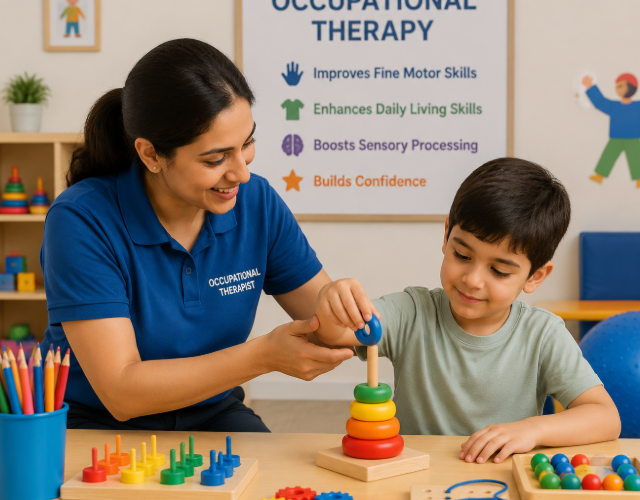
Occupational therapist helps a child stack colorful rings during therapy, with an OT poster visible in the background

How Occupational Therapy Helps Children with Learning Difficulties

Occupational therapy for learning difficulties helps children who struggle with reading, writing, focus, coordination, or classroom tasks due to underlying developmental skill gaps. These challenges are often mistaken for lack of effort, but in reality, they may be linked to fine motor delays, sensory processing issues, attention difficulties, or visual-motor coordination problems.

When these foundational skills are not fully developed, everyday school activities become harder, affecting both academic performance and confidence. Occupational therapy focuses on identifying these gaps and strengthening the core skills required for effective learning. This includes handwriting ability, attention control, sensory regulation, and task organisation. Early intervention can significantly improve long-term academic outcomes and reduce frustration in daily school life.

Doctor’s Quote

“Children with learning difficulties often struggle not because of intelligence, but due to gaps in sensory processing, attention, or motor skills. Occupational therapy helps bridge these gaps through structured skill-building activities.” Says Senior Occupational Therapist Dr.Sushant Sarang | PhD. Scholar and Senior Occupational Therapist in Navi Mumbai

Struggling with school tasks? An OT assessment can help understand your child’s learning needs.

What Are Learning Difficulties?

A young girl in a yellow shirt presses an open book to the wall, as colorful letters float around her, suggesting learning or reading themes

Learning difficulties refer to neurological or developmental challenges that affect how a child processes information. These may impact reading, writing, math, attention, or classroom participation.

Common conditions include:

  • Dyslexia
  • Dysgraphia
  • Dyscalculia
  • ADHD-related attention difficulties
  • Processing and comprehension disorders

These conditions are classified under specific learning disorders and may vary in severity from child to child.

What Is Occupational Therapy?

Occupational therapy is a child-focused intervention that builds skills needed for daily functioning. In children, “occupations” include school activities, play, self-care, and social participation.

Pediatric occupational therapy focuses on improving:

  • Motor coordination
  • Sensory processing
  • Attention and focus
  • Visual-motor integration
  • Independence in daily routines

How OT Helps with Learning Difficulties

Occupational therapy works by targeting the underlying skills behind learning, not just the symptoms. Through structured, play-based activities, it strengthens the abilities a child needs to read, write, focus, and participate confidently in the classroom.

Improving Fine Motor Skills & Handwriting: OT strengthens hand control, grip, and coordination, improving handwriting clarity and reducing fatigue.

Enhancing Focus & Attention: Children learn self-regulation strategies to improve task completion and reduce distractibility.

Supporting Sensory Processing: Sensory integration techniques help children manage sensitivity to sound, touch, and movement.

Building Visual-Motor Skills Improves reading, copying from the board, and writing alignment through eye-hand coordination.

Developing Executive Function: Supports planning, memory, organisation, and multi-step task execution.

Boosting Confidence & Independence: Small skill improvements help children feel more capable and confident in school settings.

If your child avoids writing or loses focus easily, an OT evaluation can guide the next step.

When Should You Consult an Occupational Therapist?

If your child struggles with handwriting, gripping objects, balance, or daily tasks like dressing and eating, it may be time to consult an occupational therapist. Watching for these early signs can help you decide whether a professional evaluation is worth considering:
  • Poor handwriting or slow writing speed
  • Difficulty holding a pencil properly
  • Easily distracted during tasks
  • Avoids writing or reading activities
  • Trouble following instructions
  • Clumsiness or coordination issues
  • Difficulty with daily routines
At Tender Touch Therapy Clinic, a Child Development Centre in Navi Mumbai, an occupational therapist begins with an assessment to identify the specific area of difficulty before starting any therapy. With the right therapy plan and early support, children can build skills more effectively, improve confidence, and show faster progress in daily activities.

What to Expect in an OT Session

Teacher in blue scrubs helps a young boy practice writing letters at a classroom table, pointing to a lined practice sheet with the letter 'd' repeated many times

An occupational therapist begins with a detailed OT assessment to understand the child’s strengths and challenges.

Sessions typically include:

  • Play-based motor activities
  • Sensory integration exercises
  • Handwriting practice
  • Focus-building tasks
  • Coordination and balance activities

Parents are guided with home strategies for consistent improvement.

By strengthening foundational abilities, OT helps children become more confident and capable in academic environments. Early identification and structured intervention can significantly improve long-term learning outcomes.

If learning challenges are affecting your child’s school performance, consulting a pediatric occupational therapist can help develop the right intervention plan. Book a session today.

FAQs

1. At what age should occupational therapy start for learning difficulties?

OT can begin as early as preschool when developmental delays or learning challenges are first noticed. Early support improves foundational skill development and school readiness.q

No. OT supports mild, moderate, and severe learning challenges by improving functional skills like handwriting, attention, and coordination.

Progress varies, but many children show improvement within weeks to months depending on consistency, severity, and therapy goals.

No. OT complements special education by improving underlying developmental skills that support academic learning.

Yes. OT helps improve attention, handwriting, sensory regulation, and organisation skills in children with ADHD and dyslexia.

External References

  • WHO – https://www.who.int
  • CDC – https://www.cdc.gov
What Are the Signs of ADHD in Children

What Are the Signs of ADHD in Children?

ADHD symptoms centre around three core categories: inattention, hyperactivity and impulsivity. A child who cannot hold focus, one who cannot sit still, and one who acts before thinking may all have ADHD. Sometimes all three patterns show up in the same child. Sometimes just one dominates. These traits typically appear before age 12 and show up consistently across school, home and social settings. Not occasionally. Every day, in ways the child cannot simply choose to stop.

According to Dr. Sushant D. Sarang, Occupational Therapist in Navi Mumbai at Tender Touch Therapy Clinic, “ADHD is often treated as a behaviour problem when the real issue is how the brain is managing attention and impulse regulation. Identifying the specific pattern early changes what kind of support actually helps.”

What Are the Common Signs of ADHD to Watch For?

ADHD does not present the same way across children. One child disrupts the entire classroom. Another sits quietly and fails every assignment because no one can see what is happening inside their head.

Difficulty staying on task: The child starts things but rarely finishes them. Homework takes three hours not because they are slow but because attention keeps slipping away mid-sentence. Teachers describe them as easily distracted or away with the fairies.

Forgetting instructions immediately: A child with inattentive ADHD can hear a two-step instruction and lose the second part before acting on the first. This gets labelled as not listening when the child genuinely cannot hold the sequence.

Constant movement and restlessness: Fidgeting, leaving the seat, running when walking is expected, talking over others. Hyperactive ADHD looks like a child who simply cannot power down. Telling them to sit still without understanding why they cannot is where most interventions fail.

Acting without thinking: Blurting answers out, grabbing things, interrupting, making decisions with no thought of what happens next. Parents and teachers read this as rudeness. It is not. The regulatory system that is supposed to apply the brakes is not doing its job.

A full occupational therapy assessment identifies which pattern is most disruptive for that specific child before any programme begins. For children where ADHD is affecting school participation and daily function, occupational therapy for ADHD targets the underlying regulatory gaps directly.

How Does ADHD Affect a Child's Daily Life?

Most families seek help well after the difficulties have been building. ADHD does not stay in the classroom. It creates friction across every part of the day, and the load accumulates.

School performance: A child who cannot sustain attention long enough to finish work produces far less than they are capable of. The gap between ability and output is one of the most consistent signs of ADHD in a school setting.

Friendships: Impulsivity and poor turn-taking make social situations hard. Other children find the behaviour unpredictable. The child with ADHD often has no idea why friendships keep breaking down.

Home routines: Getting dressed, packing a bag, sitting through a meal each require a sequence of steps and sustained attention. ADHD makes all of it harder than it looks from the outside.

Self-esteem: A child told repeatedly that they are not trying, not listening or not behaving eventually internalises it. By middle school many children with unidentified ADHD carry significant anxiety on top of the original difficulty.

Sleep: Many children with ADHD struggle to wind down at night. The brain stays activated well past when the day has ended, which compounds everything the next morning.

Early identification matters. Children who get targeted support before secondary school tend to carry fewer secondary difficulties into adolescence. The blog on benefits of occupational therapy for kids with ADHD covers what OT specifically addresses in children with ADHD.


Why Choose Tender Touch Therapy Clinic?

Dr. Sushant D. Sarang is a PhD Scholar in Occupational Therapy with Sensory Integration certification at Level I and IV from the USA. He founded T3 Clinic in 2007 and has built a specialist paediatric team across four Navi Mumbai locations. Six therapists work exclusively with children, and over 2 lakh therapy sessions have been delivered to date.For children presenting with ADHD concerns, the assessment at T3 Clinic goes beyond a standard checklist. It establishes which regulatory systems are most affected, where those gaps are showing up day to day, and what the child’s actual daily environment looks like at home and at school. Therapy is built from that picture. Parents get session updates on what was targeted and what changed. Approaches that are not producing results get replaced.

If your child is showing signs of ADHD, early assessment gives you a clear picture of what is happening and what to do next. Book a consultation with T3 Clinic today.

Early support can make a real difference in your child’s focus and confidence.Book a consultation today to get a clear sensory and ADHD assessment.

FAQs

Can a child have ADHD without being hyperactive?

Absolutely. Inattentive ADHD is the type most often missed, especially in girls who tend to mask well. The child looks fine from the outside, quiet, seated, not causing trouble but is barely absorbing anything in the classroom.

As early as four, though, most families do not get a clear answer until primary school when the academic and social demands start exposing the gaps. Waiting for a formal diagnosis before seeking assessment is not necessary.

The brain does not simply outgrow it. What changes over time is how well a person learns to work around it. Children who get the right support early tend to build those strategies before the demands of secondary school and adolescence hit.

It addresses the parts medication does not reach sensory regulation, motor planning, attention stamina and daily routine management.For many children it is the piece that makes everything else work better.


Disclaimer: This blog is for informational purposes only and is not a substitute for professional medical advice.

Young boy in a blue shirt sits at a table with colorful blocks, resting his chin on his hand and looking upward, with cartoon thought bubbles above his head in a bright playroom

Why Do Some Children Walk and Talk Later Than Their Peers?

Some children walk and talk later than their peers because of differences in muscle strength, hearing, brain processing, or simply their own pace of growth. Most catch up without help. Others need early therapy that builds motor control, speech, and confidence. Spotting delays early gives every child the best chance at strong long-term development.

“A late milestone is not always a warning sign. But when a child lags well behind peers, the brain and body usually need targeted support. Young brains adapt fast, so the earlier we start therapy, the smoother walking, talking, and daily routines become for the whole family.”

Dr. Sushant Sarang, Senior Occupational Therapist | Chief Mentor, Child Development Centre in Navi Mumbai


Worried about your child’s progress? Talk to a specialist and start a structured plan today.

What Counts as a Developmental Delay?

Two babies playing indoors on a light rug: one stands and smiles, the other crawls nearby

A developmental delay occurs when a child reaches key milestones noticeably later than the typical age range. Timing alone doesn’t always indicate a problem, as there is a broad spectrum of normal motor and language development.

  • Walking range: Most children begin walking between 9 and 18 months independently. Some toddlers experience delayed walking, but variations within this range are usually normal.
  • Talking range: First words often appear around 12–18 months, with simple two-word phrases emerging by age two. Late speech milestones are common and can still fall within healthy development.
  • Watch point: Seek professional guidance if a child isn’t walking by 18 months or hasn’t spoken any words by 18 months. Persistent speech or motor delays may need evaluation.
  • Big picture: A single late skill is less concerning than a consistent pattern across movement, play, and language development. Observing multiple areas together helps identify whether there’s an early childhood developmental delay that warrants intervention. 

Every child grows on their own clock. Concern starts when several areas fall behind at once.

What Causes Late Developmental Milestones?

Late walking or talking milestones rarely have a single cause. Multiple factors often interact to influence a child’s pace of motor and language development:

  • Muscle strength/Tone: Tonal abnormalities or weak core muscles can slow crawling, standing, and those first wobbly steps, contributing to delayed walking in toddlers.
  • Hearing difficulties: Recurrent ear infections or undetected hearing loss can affect a child’s ability to recognise sounds, slowing speech milestones and leading to delayed speech development.
  • Premature birth: Babies born early often reach milestones according to their corrected age rather than actual birth date, which can make them seem “late.”
  • Limited stimulation: Fewer opportunities for floor play, verbal interaction, or guided activities reduce practice in motor skills and language learning, potentially delaying walking or speech.
  • Other factors: Genetics, temperament, and family dynamics can subtly shift developmental timelines. On their own, these do not indicate a problem

However, conditions like Cerebral Palsy, Global Developmental Delay, or epilepsy may affect developmental milestones and may require medical evaluation and support.

Want to talk through your child’s milestones? Book a consultation for a developmental assessment.

When Should Parents Seek Help?

Early checks ease worry and catch real issues sooner. Trust your instinct when progress seems stuck.

  • No babbling: Little sound or gesture by 12 months calls for a hearing and speech check.
  • Lost skills: Any loss of words or abilities once gained needs prompt evaluation.
  • Stiff or floppy: Unusual muscle tone, poor balance, or constant toe-walking should be assessed.

A short assessment often brings relief. When therapy is needed, starting young makes the biggest difference.

Activities Parents Can Try at Home

A woman and a young boy sit on a rug, stacking colorful wooden blocks into a tower

Daily, playful activities at home can naturally boost motor skills development and support speech milestones in toddlers. Consistent, simple practice helps children gain strength, coordination, and language skills while keeping learning enjoyable.

Floor play for movement:

Activities like tummy time, crawling races, or climbing over cushions strengthen the core, legs, and balance needed for walking. These exercises are especially helpful for children with delayed walking in toddlers or motor development delays.

Narrate the day for language growth:

Name objects, describe actions, and talk through routines throughout the day. This boosts vocabulary acquisition and supports children with late speech development or language delays in children.

Read together daily:

Sharing picture books improves attention, comprehension, and expressive language. Reading also enhances early childhood developmental milestones while building emotional bonding.

Limit screen time:

Interactive, back-and-forth conversation is far more effective for speech and language learning than passive screen exposure. Encourage talking, singing, and asking questions.

Keep it playful:

Children learn best when activities feel like games, not drills. Playful repetition strengthens both motor skills and speech development, helping toddlers progress at their own pace.

Tip: Incorporate these activities into daily routines. Even short, fun sessions multiple times a day can make a significant difference in early childhood development, especially for children with delayed motor or speech milestones.

When Should You Consider Therapy for Developmental Delay?

If your child is missing motor or speech milestones, early therapy often makes the biggest difference. At Tender Touch Therapy Clinic in Navi Mumbai, paediatric occupational therapists, speech therapists, and special educators work as one team. Each child begins with a full developmental assessment, followed by a therapy plan matched to their specific needs.

Parents are guided through simple home exercises too, so progress continues between sessions and families stay involved at every stage.

Give your child the support they deserve. Book a consultation and explore a plan that works at home and in therapy.

FAQs

When is late walking a real concern?

 When a child is not walking independently by 18 months of age.

 Yes, many catch up fully, especially with early speech support.

 Often, though corrected age usually explains most of the gap.

 Occupational and speech therapy target motor and language skills directly.

Yes, daily floor play, talking, and reading make a big difference.

Signs Your Child Has Sensory Processing Issues

Signs Your Child Has Sensory Processing Issues?

Sensory processing issues affect how a child’s brain receives and organises input from the environment. A sound that goes unnoticed by most children may feel physically painful to one with sensory hypersensitivity. Another child may seek constant movement, touch or noise because their nervous system needs more input to feel regulated. These are not behavioural problems. They are neurological differences that show up in daily life.

According to Dr. Sushant D. Sarang, Occupational Therapist in Navi Mumbai at Tender Touch Therapy Clinic, “Sensory processing difficulties are often mistaken for stubbornness or attention problems. The child is not choosing to react that way. Their nervous system is telling them the environment is unsafe or unbearable.”

What Are the Common Signs of Sensory Processing Issues in Children?


No two children with sensory processing difficulties present the same way. One avoids everything; another cannot get enough. Both are struggling, just at opposite ends of the same system.

Extreme sensitivity to sound: A vacuum cleaner, a school bell or background noise in a restaurant can trigger genuine distress. The child covers their ears, cries or tries to leave. To them, the sound is not loud. It is overwhelming.

Clothing refusal: Tags, sock seams or certain fabric textures cause real physical discomfort, not fussiness. Mornings become a standoff over what the child will and will not wear, which most parents eventually stop trying to explain to others.

Constant movement seeking: Spinning, crashing, jumping off furniture or hanging upside down are not discipline problems. The nervous system is chasing input it cannot get from sitting still. Taking that outlet away makes the behaviour worse, not better.

Overload in busy environments: Birthday parties, school assemblies and busy shops push some children past their threshold fast. The shutdown or meltdown that follows is not bad behaviour. The system ran out of capacity, full stop.

A full assessment identifies which sensory systems are involved before any sessions begin. For children where these difficulties are showing up at school, sensory integration therapy works directly on the processing gaps underneath the behaviour.

How Do Sensory Processing Issues Affect a Child's Daily Life?

Most parents notice one or two difficult moments before they see the full picture. What makes sensory processing issues hard to manage is that the demands never stop every part of the day carries sensory load.

School performance: A child spending energy on staying regulated in a noisy classroom has very little left for the lesson. The writing falls behind. The reading does not stick. Teachers see a child who is not trying, when the child is actually exhausted from something no one can see.

Sleep: The nervous system in a sensory-sensitive child does not switch off easily. Winding down requires a transition that many of these children find genuinely difficult. Late nights and early waking are common, which compounds everything else.

Friendships: Avoiding touch or reacting badly to noise makes playdates and group activities stressful. Other children notice. The child who always pulls away or covers their ears gets left out, not out of cruelty but because no one understands why they react that way.

Home routines: Mornings, mealtimes and bedtimes each carry their own sensory demands. When all three become daily battles the household pressure builds fast. Siblings notice. Parents burn out.

Emotional regulation: A child already stretched thin by sensory demands has almost no buffer when things go wrong. Transitions, disappointments and unexpected changes hit harder. The meltdown is not the problem it is what happens when the load has been too high for too long.

Younger children tend to build coping capacity faster with targeted support, but older children respond well too. For further reading on how sensory and behavioural patterns connect, the blog on how sensory integration therapy helps children with autism covers the overlap in detail.

Why Choose Tender Touch Therapy Clinic?

Dr. Sushant D. Sarang is a PhD Scholar in Occupational Therapy with Sensory Integration certification at Level I and IV from the USA. He founded T3 Clinic in 2007 and has built a team of six occupational therapists working exclusively with children across four Navi Mumbai locations. Over 2 lakh therapy sessions have been delivered to date.

For children presenting with sensory concerns, the clinic’s assessment goes beyond a checklist. It maps out which systems are over-responding, which are barely registering and exactly where those patterns are creating the most difficulty  in the classroom, at mealtimes, during transitions or at home. Therapy is built from that profile. Parents get session updates on what was worked on and what moved. If an approach is not producing change, it gets replaced.

Give your child the right sensory support early build focus confidence.Start early sensory support for better focus, confidence and daily development.

FAQs

At what age can sensory processing issues be identified in children?

Signs can appear as early as infancy. Formal occupational therapy assessment is appropriate from age two onwards, though early behavioural patterns are worth discussing with a therapist at any age.

No. Sensory processing difficulties occur across many conditions including ADHD, developmental delay and anxiety, and also independently. An OT assessment identifies the specific sensory profile regardless of diagnosis.

Yes. Sensory integration therapy helps the nervous system build tolerance and improve processing over time. Most children show measurable changes in daily function with consistent sessions..

A standard developmental check covers broad milestones. An OT sensory assessment maps how each sensory system processes input and identifies which specific gaps are driving the child’s difficulties in daily life.


Disclaimer: This blog is for informational purposes only and is not a substitute for professional medical advice.
Hands assembling bright color geometric shapes (hexagons and triangles) on a light surface

How Sensory Integration Therapy Helps Children with Autism

Sensory integration therapy helps children with autism process sights, sounds, touch, and movement without feeling overwhelmed. Through swings, brushes, weighted tools, and play-based exercises, therapists improve attention, behaviour, motor skills, and daily routines such as eating, dressing, and sleeping. Early therapy fosters confidence, reduces frustration, and supports smoother social interactions.

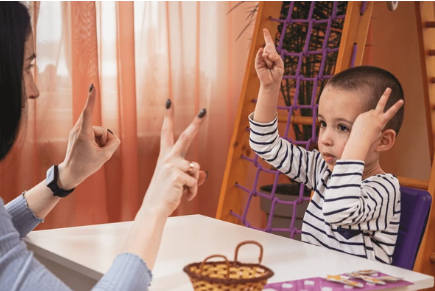
Adult and child at a table using hand signs to communicate

 “Autistic children do not act out by choice. Their brains process sounds, touch, and movement differently. Once we calm the sensory system through structured therapy, focus improves, meltdowns reduce, and daily tasks like eating, dressing, and sleeping become manageable for the whole family.” Says Dr. Sushant Sarang, Ph.D. Scholar & Senior OT, Chief Mentor at Tender Touch, Navi Mumbai, with 27+ years of experience

Get personalized support today – consult an expert to start a structured sensory program for your child.

What is Sensory Integration Therapy?

Sensory integration therapy helps children’s brains organise and respond appropriately to sensory input. It combines structured play, physical exercises, and therapist guidance to reduce sensory overload.
  • Brain Processing: Helps the brain organise input from all seven senses. Children learn to respond calmly to stimuli rather than reacting with anxiety or withdrawal.
  • Play-Based: Uses swings, ball pits, textures, and obstacle courses. Play keeps sessions engaging while providing meaningful sensory input.
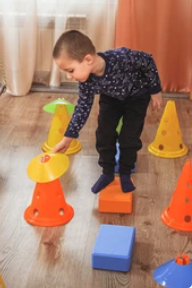
A boy arranges orange traffic cones and blue foam blocks on a wooden floor as part of an indoor obstacle course
  • Therapist-Led: Conducted by trained paediatric occupational therapists. Therapists observe responses, adjust exercises, and ensure safety at all times.
  • Individual Plans: Each child receives a custom sensory diet. Tailored programs address unique sensitivities and developmental goals.

Common Sensory Challenges in Autistic Children

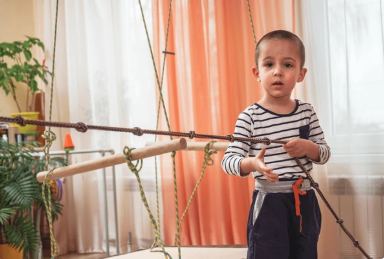
Boy standing at an indoor rope climbing structure, wearing a striped shirt and dark pants, looking at the camera

Autistic children often experience sensory difficulties that affect daily routines, learning, and social interaction. Therapy is designed to reduce these sensitivities gradually.

  • Sound Sensitivity: Reacts to vacuums, fans, or crowded spaces. Children may cover their ears or cry, which impacts school and play.
  • Touch Issues: Refusal to accept certain textures, haircuts, or clothing tags. Small daily routines like dressing or eating may become stressful.
  • Movement Needs: Excessive spinning, jumping, or rocking. High activity helps regulate sensory input but can interfere with attention and safety.
  • Visual Overload: Avoids eye contact or bright lights. Overstimulation can cause anxiety or withdrawal from social situations.

How Sensory Integration Therapy Helps

Therapy provides measurable benefits that improve quality of life. Sessions focus on regulating the nervous system and building functional skills.

  • Better Focus: A calmer nervous system improves classroom attention and engagement in activities. Children can complete tasks with less frustration.
  • Improved Behaviour: Reduced meltdowns and aggressive episodes. Predictable sensory routines create a sense of security.
  • Motor Skills: Strengthens balance, coordination, and handwriting. Therapy encourages smooth movement and improved posture.
  • Daily Living: Easier routines like bathing, brushing, eating, and sleeping. Children gain independence in personal care and household tasks.


Give your child the support they deserve — start a structured sensory program today and see the difference in focus and confidence.

Sensory Integration Activities Parents Can Try at Home

Father helping young girl play with textured balls on a bed in a bright room

Home practice reinforces clinic progress. Simple, safe activities can enhance sensory regulation when guided by a therapist.

  • Heavy Work: Pushing, pulling, or carrying weighted items. Builds proprioception and helps children feel grounded.
  • Swinging: 10 minutes of linear swinging before homework. Supports focus and prepares the child for structured tasks.
  • Brushing Protocol: Gentle strokes with soft brushes, only with therapist guidance. Helps with tactile sensitivity and calming.
  • Textured Play: Rice bins, kinetic sand, or finger paints. Encourages exploration, creativity, and fine motor development.

Sensory integration therapy helps children manage sensory challenges and improve focus in a structured, safe environment.

Why Choose Tender Touch for Sensory Integration Therapy?

Tender Touch is a trusted Child Development Center in Navi Mumbai, providing structured sensory integration therapy for autistic children. Our multidisciplinary team includes paediatric occupational therapists, speech therapists, and special educators under one roof.

Each child receives an individual sensory profile assessment and a customized therapy plan. Parents are trained to reinforce skills at home, ensuring continuity and confidence in care.

Take the next step for your child’s growth — book a consultation and explore personalized sensory activities that work at home and in therapy.

FAQs

What is sensory integration therapy for autism?
A play-based therapy helping autistic children process sensory input without distress.
Optimal results come from starting between the ages of 2 and 7 years.
Most children attend 2–3 sessions weekly for 6 to 12 months.
Yes, with a therapist-designed sensory diet and parent guidance.
Yes, outcomes vary depending on individual sensory profiles and therapy consistency.
How Speech Therapy Helps Children With Autism

How Speech Therapy Helps Children With Autism?

How Does Speech Therapy Help Children With Autism?

Speech therapy helps autistic children develop communication skills needed for daily life including using words, understanding language, making requests and interacting with people. Autism affects communication differently in every child. Some are non-verbal. Others have language but struggle to use it in social situations. Speech therapy works on whichever part of that picture is most affected for that specific child.

According to Dr. Sushant D. Sarang, Occupational Therapist in Navi Mumbai, “Communication in autism isn’t just about words. A child who can’t regulate their sensory system or process their environment is going to struggle to communicate regardless of how much speech work they do. That’s why OT and speech therapy work best together.”

How Does Speech Therapy Actually Work for Autistic Children?

Speech Theropy
Speech Theropy

The approach depends entirely on where that child’s communication is breaking down. Two autistic children in the same session can be working on completely different things.

  • Augmentative and Alternative Communication: For children who are non-verbal or have very limited speech AAC gives them a functional way to communicate before verbal language develops. This might be picture exchange systems, communication boards or speech-generating devices. The goal is giving the child a working communication channel right now rather than waiting for speech to arrive.
  • Receptive Language: Understanding what other people say is a separate skill from producing speech and many autistic children struggle with it significantly. Following instructions, understanding questions, processing what a teacher just said — receptive language work addresses the comprehension side directly rather than focusing only on output.
  • Social Communication: Having words is one thing. Knowing when to use them, how to start a conversation, how to take turns in an exchange, how to read what the other person is expecting — these are social communication skills and they’re often the main difficulty for autistic children who do have functional speech.
  • Verbal Articulation and Fluency: Some autistic children have speech that is difficult for others to understand because of how sounds are formed or how words come out. Articulation therapy works on the physical mechanics of speech production so the child’s communication actually lands with the people around them.

Speech therapy works best when the assessment maps exactly where the breakdown is before sessions start because the work looks very different depending on the answer. For children where sensory processing is also affecting communication the blog on sensory integration therapy for autistic kids explains how SI and speech therapy address different parts of the same problem.

What Changes Do Families Actually Notice After Speech Therapy?

Progress in speech therapy for autism doesn’t follow a clean upward line. It stalls, jumps forward unexpectedly and sometimes looks like nothing is happening for weeks before something clicks.

  • Requests Start Appearing: A child who used to melt down when they needed something starts pointing, handing over a picture card or using a device to communicate that need. The meltdown wasn’t defiance. It was a child with no other way to get information out. Once there is a channel the frequency drops noticeably.
  • Following Instructions Gets Easier: A child who seemed to ignore everything said to them starts responding to simple instructions then two-step ones. This is receptive language developing and it changes classroom life significantly. Teachers notice it before parents do in most cases.
  • Social Interaction Opens Up Slightly: A child who only spoke when spoken to directly starts initiating conversation in small ways. Or starts waiting for a response before continuing. These are tiny shifts that families track carefully because they know how much work sits behind each one. Play therapy alongside speech therapy helps build the social interaction side further for children who need structured support in that area.
  • Frustration Reduces at Home: When a child can communicate even basic needs and feelings the daily meltdowns that come from being misunderstood start reducing. Not gone. But the household runs differently when the child has a reliable way to get information across.

Speech therapy for autism is a long-term commitment and families need to go in knowing that. Read more on what occupational therapy for children actually is.

Why Choose Tender Touch Therapy Clinic?

Dr. Sushant D. Sarang is a PhD Scholar in Occupational Therapy with Sensory Integration certification at Level I and IV from the USA and has been running T3 Clinic since 2007 across four Navi Mumbai locations with six specialist therapists working only with children.

Every child starts with a full individual assessment before sessions begin. Therapy is built around how that specific child is functioning right now and adjusted as things change. If something stops producing results it gets changed. Parents get specific updates on what was worked on and what shifted.


FREQUENTLY ASKED QUESTIONS

How long does speech therapy take to show results in autistic children?

Most autistic children need 6 to 12 months of consistent sessions before communication changes become stable.

Can speech therapy help a non-verbal autistic child?

Yes AAC-based speech therapy gives non-verbal children a functional communication channel before verbal speech develops.

Does speech therapy work alongside occupational therapy for autism?

Yes OT and speech therapy address different systems and produce better outcomes when running together.

What age should an autistic child start speech therapy?

Early intervention before age 5 produces the strongest outcomes though older children also respond well.

References

  1. American Speech-Language-Hearing Association — Autism Spectrum Disorder
  2. National Health Service UK — Speech and Language Therapy for Autism
Benefits of Occupational Therapy for Kids With ADHD

Benefits of Occupational Therapy for Kids With ADHD

What Are the Benefits of Occupational Therapy for Kids With ADHD?

Pediatric occupational therapy is a healthcare service that helps children develop the physical, sensory and cognitive skills needed for everyday tasks. These daily activities include playing, learning in school, eating and basic self-care routines like getting dressed and managing personal hygiene. Children with ADHD often struggle across several of these areas at once because ADHD affects how the brain regulates attention, sensory input and the ability to follow multi-step routines. OT works on each of these gaps individually through structured sessions built around that specific child.

According to Dr. Sushant D. Sarang, Occupational Therapist in Navi Mumbai, “ADHD is often treated as a behaviour problem when the real issue is how the brain is managing sensory input and task switching. OT works on those underlying systems directly.”

What Does Occupational Therapy Actually Target in Children With ADHD?

Benefits of Occupational Therapy for Kids

ADHD brings different problems for different children. One child can’t sit still long enough to write a sentence. Another can sit fine but can’t get dressed without falling apart. The assessment figures out which gap is actually driving the most difficulty for that particular child.

  • Attention and Task Persistence: Sitting through a task long enough to finish it is genuinely difficult for children with ADHD. OT uses structured activities that gradually build the capacity to stay on something without constant redirection. The activity level is calibrated so the child gets through each one without hitting overload — then the next session asks a little more.
  • Sensory Regulation: Many children with ADHD are sensory seekers. They fidget, make noise, touch everything and struggle to feel settled in a quiet classroom because their nervous system needs more input than that environment offers. OT works out what that child’s system is actually chasing and gets it into the day in a structured way so the classroom isn’t the first place they’re trying to regulate.
  • Fine Motor Skills: Handwriting is a common struggle for children with ADHD. Slow processing, poor pencil grip and difficulty coordinating hand movements mean written work takes far longer and produces far less than the child is actually capable of. The handwriting problem usually has a motor problem underneath it and that is what OT addresses.
  • Organisation and Routine: Getting dressed in the morning. Packing a school bag. Following a sequence of steps without losing track halfway through. Children with ADHD often need these broken into very small steps and practised repeatedly in the same order. The sequence only starts to stick once it has been done the same way enough times.

A full occupational therapy assessment identifies which area is causing the most disruption before sessions begin. For children where sensory regulation is a significant concern the blog on how sensory integration therapy helps autistic kids covers how sensory processing and behaviour connect in detail.

What Changes Do Families Actually See After OT for ADHD?

Parents often miss the early changes because they’re watching the wrong things. The shifts tend to show up in mundane daily situations weeks before anyone flags progress formally.

  • School Work Gets More Manageable: A child who used to avoid all written tasks starts producing a few sentences then a paragraph. Handwriting doesn’t become perfect but the refusal stops. This usually has nothing to do with motivation — it comes from the motor work done in sessions.
  • Morning Routines Settle Down: Getting a child with ADHD dressed and out the door without a daily fight is something a lot of families have quietly given up on. When OT breaks those routines into repeatable steps and practises them consistently the mornings get less chaotic over time. Behavioral therapy alongside OT helps reinforce these changes for children who also struggle with emotional regulation.
  • Sitting Tolerance Increases: A child who couldn’t last five minutes at a desk starts managing ten then fifteen. Teachers tend to notice this first because they’re with the child every day in a setting that makes this demand constantly.
  • Emotional Regulation Improves: When the sensory system is getting what it needs and daily tasks stop feeling impossible the meltdowns that come from overload and frustration become less frequent. The triggers don’t go away but the response gets smaller and recovery happens faster.

Children who start OT younger tend to see faster gains but older children respond too — the work is the same either way. Read more on what occupational therapy for children actually is.

Why Choose Tender Touch Therapy Clinic?

Dr. Sushant D. Sarang is a PhD Scholar in Occupational Therapy with Sensory Integration certification at Level I and IV from the USA and has been running T3 Clinic since 2007 across four Navi Mumbai locations. Six occupational therapists on the team working only with children.

Every child gets a written individual assessment before sessions begin. Therapy is specific to how that child is functioning at that point and gets adjusted as things change. If an approach isn’t moving things forward it gets dropped. Parents get session updates on what was worked on and what shifted.

📞 Call Now: +91 96193 44305

FREQUENTLY ASKED QUESTIONS

Does occupational therapy help children with ADHD who are already on medication?

Yes, OT works alongside medication by addressing functional and sensory gaps medication does not cover.

How long does OT take to show results in children with ADHD?

Most children show noticeable changes in daily function within 8 to 12 consistent weekly sessions.

Can occupational therapy help an ADHD child who struggles mainly at school?

Yes, OT targets the attention, motor and sensory gaps that directly affect school performance.

Does a child need an ADHD diagnosis before starting occupational therapy?

No, OT assessment identifies functional difficulties and builds a programme regardless of formal diagnosis.

References

  1. American Occupational Therapy Association — ADHD and OT
  2. World Health Organization — Child and Adolescent Mental Health
Caregiver in blue scrubs helping a young child with a colorful stacking toy on a padded play mat

Occupational Therapy for ADHD

Occupational Therapy for ADHD

Boy concentrating as he assembles a small brick toy house on a table, with loose bricks nearby

For many children with ADHD, the challenge isn’t a lack of intelligence or effort; it’s that their brains are wired to process the world differently. Staying focused during a homework session, following multi-step instructions, keeping a backpack organised, or simply sitting still through a meal can take far more mental energy than it does for their peers. Over time, these daily struggles can quietly erode a child’s confidence and make even routine moments feel overwhelming.

ADHD affects far more than attention. It can influence how a child regulates their emotions, coordinates their body, manages impulses, and builds the habits that form the backbone of independent daily life. These effects ripple across the classroom,  playground, and home, making it essential that support goes beyond academic help alone.

Doctor Quote

“Children with ADHD often have strong potential, but they may need help turning that potential into daily success. Occupational therapy focuses on simple skills that create long-term confidence.”
Dr. Sushant Sarang, Senior Occupational Therapist, Ph.D. Scholar, Advanced Sensory Integration Trained, 27+ years of experience

Turn daily struggles into small wins—start building better focus today.

What Is Occupational Therapy for ADHD?

Occupational therapy helps children improve the everyday skills they need to function well. For ADHD, this often means working on focus, self-control, planning, coordination, and routines.

It is not only about therapy sessions. The real goal is to make life easier at home, smoother in school, and more manageable for the child.

A good Child Development Center in Navi Mumbai creates therapy plans based on the child’s age, strengths, and challenges.

Who Needs This Treatment?

Caretaker in white coat assisting a child in a wheelchair, adjusting the child's shoe while seated indoors

Children may benefit from therapy if they regularly face issues such as poor attention, impulsive behavior, or difficulty following routines.

Common signs include:

  • Easily distracted during tasks
  • Trouble sitting still
  • Frequent frustration or meltdowns
  • Poor handwriting
  • Difficulty finishing homework
  • Forgetfulness
  • Sensory sensitivity
  • Low confidence due to repeated struggles

Therapy can also support teenagers who need help with planning, study habits, and independence.

Benefits of Occupational Therapy for ADHD

A smiling boy in a striped shirt stacks pink bricks and a grey roof on a small model house at a desk

When therapy is consistent, children often become more confident and independent over time.

Benefits may include:

  • Better focus during tasks
  • Improved emotional control
  • Easier homework routines
  • Better motor skills and handwriting
  • Reduced family stress
  • Stronger self-confidence
  • Improved classroom participation

Many parents notice that small daily wins lead to meaningful long-term progress.

Turn daily struggles into small wins—start building better focus today.

How the Treatment Works

Therapy usually begins with an assessment. The therapist understands the child’s behavior, routines, sensory needs, and learning challenges.

After that, sessions are planned around goals such as improving focus or managing frustration. Activities may include movement games, sensory exercises, handwriting tasks, and routine-building methods.

Parents are also guided on what to continue at home, which is an important part of progress.

Why Timely Treatment Matters

Waiting too long can make everyday struggles harder. A child who constantly feels behind may lose confidence or start resisting schoolwork.

Delayed support may lead to:

  • Academic difficulties
  • Emotional stress
  • Poor self-esteem
  • Family conflict over routines
  • Social challenges with peers

Early therapy helps children build coping skills before habits become harder to change.

Recovery & What to Expect

Occupational therapy is a gradual process. It focuses on steady progress rather than instant results.

Some families notice better listening or calmer behavior within a few weeks. Larger improvements in routines, independence, and attention often develop over a few months.

Regular attendance and home practice usually improve outcomes.

Effectiveness of the Treatment

Occupational therapy can be highly effective when the child receives the right plan and family support. It works best when parents, teachers, and therapists stay aligned.

Realistic improvements often include:

  • Better daily routines
  • Stronger attention span
  • Improved emotional balance
  • Better classroom behavior
  • More independence at home

Families  often notice that progress shows first in everyday life, not just during
Sessions.

When Should You Consult?

Doctor wearing a white coat with a stethoscope speaks with a young boy seated on an examination bench in a clinic, holding a clipboard in hand

If your child’s focus, emotions, or routines are affecting school or home life, it may be the right time to seek help.

Choosing an experienced Child Development Center early can help your child feel more confident, capable, and ready to grow.

A little guidance today can shape a calmer, more confident tomorrow.

FAQs

1. Is occupational therapy helpful for ADHD?

Yes, it helps to reduce hyperactivity and improve focus, routines, behavior, and confidence.

Occupational therapy helps improve focus, routines, emotional control, handwriting, sensory balance,reduce hyperactivity and daily independence for people with ADHD.

As soon as difficulties affect daily life or learning.

Yes, especially attention, task completion, and handwriting.

Some children improve in months, while others need longer support.

Teacher and two children look excited as they learn letters; the teacher holds a red card with the letter S for a spelling activity

Speech Therapy vs Occupational Therapy for Children

Speech Therapy vs Occupational Therapy

When parents begin researching speech therapy vs occupational therapy for children, confusion is common and completely understandable. Both therapies play a crucial role in child development, yet they address very different challenges.

Speech therapy for kids focuses on communication skills, how a child speaks, understands, and expresses language. In contrast, occupational therapy for children focuses on helping children perform everyday tasks independently, such as writing, dressing, or eating.

Understanding this difference is key to choosing the right support system for your child.

But here’s the important part… It’s not always about choosing one over the other.

What Is Speech Therapy for Kids?

Speech therapy for kids is a specialized intervention designed to improve a child’s communication abilities. This includes verbal speech, language understanding, and even nonverbal communication.

Pediatric speech therapy uses engaging, child-friendly techniques such as storytelling, games, and play-based learning to stimulate development.

Core areas addressed:

  • Speech clarity and pronunciation
  • Language comprehension and expression
  • Fluency (stammering/stuttering)
  • Social communication skills


Speech therapy targets speech, language, voice, fluency, and swallowing disorders.

Signs a child needs speech therapy:

  • Delayed speech development
  • Difficulty forming words
  • Limited vocabulary
  • Trouble following instructions
  • Social communication challenges

“Early pediatric speech therapy helps children build a strong communication foundation, improving both academic performance and social confidence,” says     Dr. Sushant Sarang, Senior Occupational Therapist | Chief Mentor, Tender Touch Therapy Clinic


What Is Occupational Therapy for Children?

Occupational therapy for children focuses on helping kids become independent in their daily lives. It strengthens physical, sensory, and cognitive skills required for everyday activities

Areas targeted in occupational therapy for children:

  • Fine motor skills (writing, gripping objects)
  • Gross motor skills (balance, coordination)
  • Sensory processing
  • Daily living activities (eating, dressing)


OT improves a child’s independence and ability to perform daily tasks such as dressing, eating, and coordinating.

Signs a child needs occupational therapy:

  • Difficulty holding a pencil
  • Poor balance or coordination
  • Sensory sensitivities
  • Trouble with self-care routines
  • Delayed motor milestones


“Occupational therapy for children plays a vital role in building independence. When sensory and motor foundations are strong, children can perform daily activities with confidence and ease.” Dr. Sushant Sarang, Ph.D. Scholar
Senior Occupational Therapist | Chief Mentor, Tender Touch Therapy Clinic


Speech Therapy vs Occupational Therapy

Speech Therapy vs Occupational Therapy

When comparing speech therapy vs occupational therapy, the distinction lies in the developmental areas they target.

AreaSpeech TherapyOccupational Therapy
FocusCommunication & languageDaily life skills
SkillsSpeaking, understanding, and social interactionMotor skills, coordination
Common IssuesSpeech delay, stutteringSensory issues, poor coordination


Speech therapy is about words, talking, and understanding. Occupational therapy is about daily tasks using hands and interacting with the physical world.

If you’re wondering, “Does my child need speech therapy or occupational therapy, identifying the primary challenge is the first step.

But here’s something many parents don’t realize…

Can a Child Have Both Speech Therapy and Occupational Therapy?

Yes, and often, this combination delivers the best outcomes.

Many children have overlapping developmental needs. For instance:

  • A child struggling with speech may also have attention or sensory challenges
  • Motor coordination issues can impact communication

Benefits of combining speech and occupational therapy:

  • Holistic child development
  • Faster and more consistent progress
  • Better integration of skills


OT builds the sensory and motor foundation, while speech therapy builds communication skills on top of it.

And that’s not all… integrated therapy often leads to long-term success.

Speech Therapy vs OT for Autism


When evaluating speech therapy vs OT for autism, both therapies are essential and complementary.

  • Speech therapy helps improve:
    • Verbal and non-verbal communication
    • Social interaction skills
    • Use of communication aids
  • Occupational therapy focuses on:
    • Sensory integration
    • Emotional regulation
    • Motor coordination


Most autistic children benefit from both therapies working together.

For conditions such as sensory processing disorder, OT is primary, with speech therapy added when communication is affected.

But what about toddlers?

 Speech Therapy vs Occupational Therapy for Toddlers

Teacher assists two toddlers stacking bright blocks at a table in a daycare playroom bedded with colorful toys for early learning outside of view group play area?

In early childhood, understanding speech therapy vs occupational therapy for toddlers is critical.

  • Speech therapy can begin as early as 18 months
  • OT supports feeding, sensory regulation, and early motor skills


Early intervention significantly improves long-term developmental outcomes.

Parents often ask, “Why did the speech therapist recommend occupational therapy?

This happens because:

  • Sensory regulation affects attention and speech
  • Postural control impacts speech clarity
  • Brain functions are interconnected

In simple terms… development works as a system, not in isolation.

How to Decide What Your Child Needs

If you’re asking, “Does my child need speech therapy or occupational therapy?” consider the following:

  • Communication difficulties → Speech therapy
  • Motor or sensory challenges → Occupational therapy
  • Multiple concerns → Combination approach

A professional assessment remains the most reliable way to make a decision.


Understanding speech therapy vs occupational therapy for children empowers parents to make informed decisions. While speech therapy for kids focuses on communication, occupational therapy for children enhances independence and daily functioning.

In many cases, the most effective approach is a combination of both therapies, ensuring holistic development and long-term success.

FAQs

  1. What is the difference between speech therapy and occupational therapy? Speech therapy focuses on communication, while occupational therapy supports daily living skills and motor development.
  2. Can my child take both therapies together? Yes, many children benefit from a combined therapy approach.
  3. What are the signs a child needs speech therapy? Delayed speech, unclear pronunciation, and difficulty understanding language.
  4. What are the signs a child needs occupational therapy? Poor coordination, sensory sensitivities, and difficulty with daily tasks.
  5. Which therapy is better for autism? Both therapies are essential and often used together for the best results.
Mother and young boy stacking colorful building blocks on a living room rug at home

Occupational Therapy for Autism

Occupational Therapy for Autism

Parents are often the first to notice when something feels “different” in their child’s development. It may begin with small observations, difficulty holding objects, delayed speech, sensitivity to sounds, or limited interaction with others. Over time, these challenges can start affecting daily routines, learning, and social behavior.

This is where occupational therapy for autism plays a meaningful role. Rather than focusing only on clinical treatment, it works on improving how a child functions in everyday life; at home, in school, and in social settings.

 “Occupational therapy focuses on enabling children to participate in everyday activities with greater independence. For children with autism, even small functional improvements can have a lasting impact on confidence and development.” Dr. Sushant Sarang, Senior Occupational Therapist, Chief Mentor, Tender Touch Therapy Clinic

Early and structured intervention often helps children gradually build skills that support long-term growth.

Symptoms of Autism Parents Should Not Ignore

While early signs of autism can differ from child to child, certain patterns frequently emerge. These signs may be subtle at first, but if they persist, it’s important to seek professional guidance early on. Recognizing these early warning signs can help ensure that your child gets the support they need at the right time.

Some commonly observed patterns are:

  • Delayed speech or communication challenges
  • Limited eye contact or social interaction
  • Repetitive behaviors or rigid routines
  • Sensitivity to sound, touch, or textures
  • Difficulty with daily tasks like eating or dressing

If these signs persist, early consultation is recommended.

How Occupational Therapy Helps Children with Autism

Autism Spectrum Disorder (ASD) affects how a child communicates, behaves, and processes sensory information. Each child presents differently, which is why therapy must be personalized.

Occupational therapy autism programs are designed to improve:

  • Communication and socialisation
  • Behaviour
  • Daily living skills such as eating and dressing
  • Fine motor skills like writing and gripping
  • Sensory processing and regulation
  • Social participation and interaction

The focus is practical,  helping children function better in real-life situations at home and school.

When to Visit an Occupational Therapist

Female doctor in a white coat with a stethoscope smiles at a young boy, holding his hands in a comforting gesture during a visit

You should consider visiting an occupational therapist if:

  • Developmental milestones are delayed: If your child is not meeting expected milestones, such as speaking, understanding language, or responding to their name, early intervention can help address these challenges.
  • Communication issues persist: Limited communication, difficulty forming sentences, or struggles with social interactions, such as making eye contact, can indicate the need for therapy to develop these skills.
  • Sensory sensitivities affect daily routines: If your child is unusually sensitive to sounds, lights, textures, or touch, and these sensitivities interfere with daily activities, occupational therapy can help them adapt and manage these responses.
  • Basic daily activities are challenging: If tasks like feeding, dressing, or grooming are difficult for your child, occupational therapy can help build the skills needed for independence in everyday life.

Early consultation with an occupational therapist can provide the guidance needed to support your child’s development and enhance their quality of life.

Why Choose T3 Clinic for Occupational Therapy in Navi Mumbai

Parents often look for a center that combines expertise with a child-friendly approach. T3 Clinic offers:

  • Vast experience of more than 19 years
  • Learnings from more than two lakh therapy sessions.
  • Experienced pediatric occupational therapists
  • Structured therapy programs tailored to each child
  • Dedicated sensory integration therapy setups
  • Parent guidance and home-based support plans
  • Child-centric environment designed for comfort and engagement

 The goal is not just therapy, but measurable progress in everyday functioning. Early intervention through pediatric occupational therapy for autism can significantly improve developmental outcomes.

Treatment Approach at T3 Clinic

Pediatrician listens to a child's heartbeat with a stethoscope while the child sits with a teddy bear and a parent nearby

At T3 Clinic, the treatment approach is structured, goal-oriented, and tailored to each child’s individual needs. It begins with a detailed assessment to understand the child’s strengths, challenges, sensory profile, and functional abilities.

Based on this, a personalized therapy plan is created with a focus on improving daily skills and achieving measurable progress. Regular monitoring and reassessment ensure that therapy evolves with the child’s development, while parent guidance helps maintain consistency at home.

Sensory Integration Therapy

Children with autism often experience sensory overload or under-responsiveness.

At T3 Clinic, sensory integration therapy for autism helps regulate these responses, allowing children to better engage with their environment.


“Sensory regulation is a key part of autism therapy. Once a child becomes more comfortable with sensory input, improvements are seen in attention, behavior, and learning,” says     Dr. Sushant Sarang

Children and adults playing in a colorful indoor playroom with swings, climbing wall, and a ball pit in the background

Parent Training & Home Support

Parents are guided with practical strategies to continue therapy at home, ensuring consistency and faster progress.

Children and caregivers in a play therapy space with colorful gym toys and climbing wall equipment nearby, smiling as they play a ball game

Benefits of Occupational Therapy for Autism

Choosing the right therapy approach can lead to meaningful long-term improvements. Children can benefit from:

  • Increased independence in daily activities
  • Better coordination and motor skills
  • Improved attention and focus
  • Reduced sensory-related stress
  • Enhanced confidence and social participation

Autism requires a structured and personalized approach. With the right support, children can develop essential life skills and improve their ability to function independently.

Occupational therapy focuses on real, measurable progress that supports both the child and the family.

FAQs

What does occupational therapy do for autism?

It helps children improve daily skills, sensory processing, motor coordination, and social interaction.

Is occupational therapy effective for autism?

Yes, it significantly improves independence, behavior, and daily functioning.

At what age should occupational therapy start?

It can begin as early as 1.5 to 2 years when early signs are observed.

How long does occupational therapy take to show results?

Results vary, but improvements are often seen within a few months of consistent therapy.

 Where can I find occupational therapy in Navi Mumbai?

 In Navi Mumbai, you can find occupational therapy at Tender Touch Therapy Clinic, offering personalized programs to improve motor skills, sensory processing, and daily living abilities.