Occupational therapy for learning difficulties helps children who struggle with reading, writing, focus, coordination, or classroom tasks due to underlying developmental skill gaps. These challenges are often mistaken for lack of effort, but in reality, they may be linked to fine motor delays, sensory processing issues, attention difficulties, or visual-motor coordination problems.
When these foundational skills are not fully developed, everyday school activities become harder, affecting both academic performance and confidence. Occupational therapy focuses on identifying these gaps and strengthening the core skills required for effective learning. This includes handwriting ability, attention control, sensory regulation, and task organisation. Early intervention can significantly improve long-term academic outcomes and reduce frustration in daily school life.
Doctor’s Quote
“Children with learning difficulties often struggle not because of intelligence, but due to gaps in sensory processing, attention, or motor skills. Occupational therapy helps bridge these gaps through structured skill-building activities.” Says Senior Occupational Therapist Dr.Sushant Sarang | PhD. Scholar and Senior Occupational Therapist in Navi Mumbai
Struggling with school tasks? An OT assessment can help understand your child’s learning needs.
What Are Learning Difficulties?
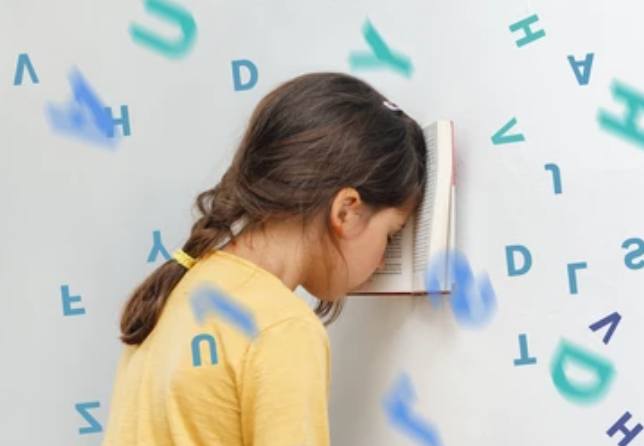
Learning difficulties refer to neurological or developmental challenges that affect how a child processes information. These may impact reading, writing, math, attention, or classroom participation.
Common conditions include:
- Dyslexia
- Dysgraphia
- Dyscalculia
- ADHD-related attention difficulties
- Processing and comprehension disorders
These conditions are classified under specific learning disorders and may vary in severity from child to child.
What Is Occupational Therapy?
Occupational therapy is a child-focused intervention that builds skills needed for daily functioning. In children, “occupations” include school activities, play, self-care, and social participation.
Pediatric occupational therapy focuses on improving:
- Motor coordination
- Sensory processing
- Attention and focus
- Visual-motor integration
- Independence in daily routines
How OT Helps with Learning Difficulties
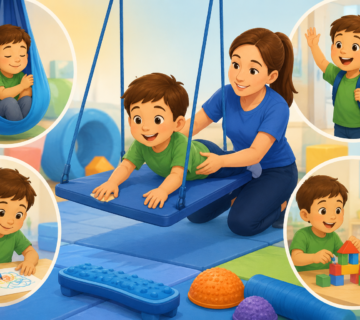
Occupational therapy works by targeting the underlying skills behind learning, not just the symptoms. Through structured, play-based activities, it strengthens the abilities a child needs to read, write, focus, and participate confidently in the classroom.
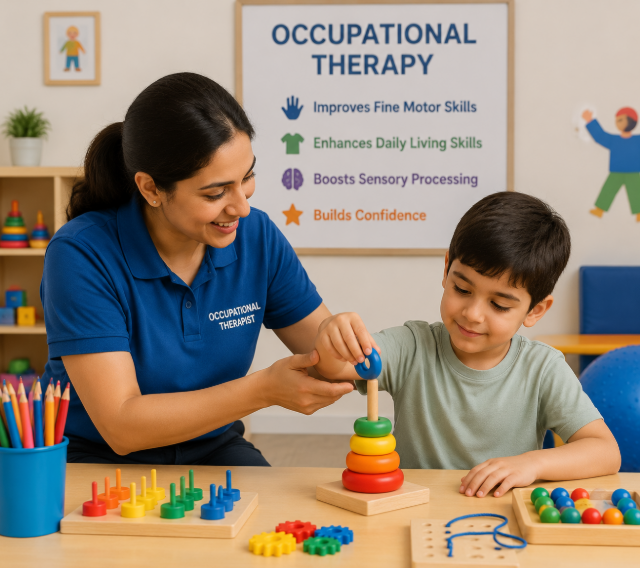
Improving Fine Motor Skills & Handwriting: OT strengthens hand control, grip, and coordination, improving handwriting clarity and reducing fatigue.
Enhancing Focus & Attention: Children learn self-regulation strategies to improve task completion and reduce distractibility.
Supporting Sensory Processing: Sensory integration techniques help children manage sensitivity to sound, touch, and movement.
Building Visual-Motor Skills Improves reading, copying from the board, and writing alignment through eye-hand coordination.
Developing Executive Function: Supports planning, memory, organisation, and multi-step task execution.
Boosting Confidence & Independence: Small skill improvements help children feel more capable and confident in school settings.
If your child avoids writing or loses focus easily, an OT evaluation can guide the next step.
When Should You Consult an Occupational Therapist?
- Poor handwriting or slow writing speed
- Difficulty holding a pencil properly
- Easily distracted during tasks
- Avoids writing or reading activities
- Trouble following instructions
- Clumsiness or coordination issues
- Difficulty with daily routines
What to Expect in an OT Session
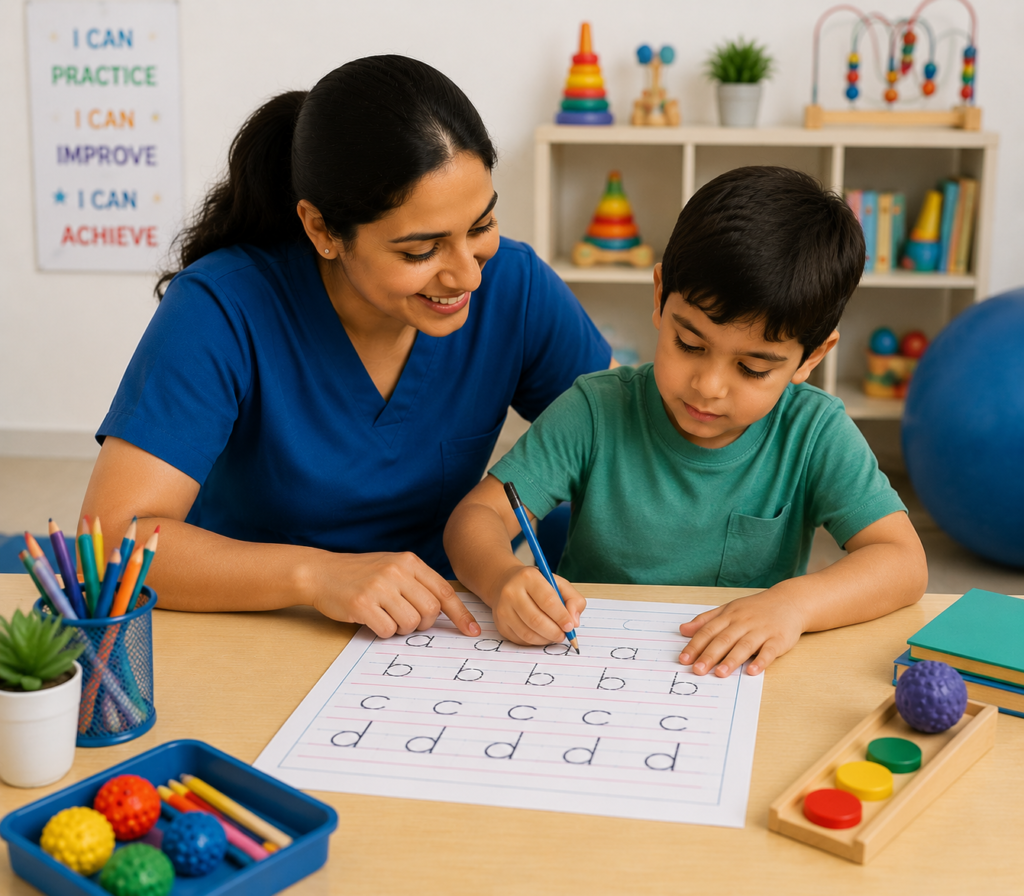
An occupational therapist begins with a detailed OT assessment to understand the child’s strengths and challenges.
Sessions typically include:
- Play-based motor activities
- Sensory integration exercises
- Handwriting practice
- Focus-building tasks
- Coordination and balance activities
Parents are guided with home strategies for consistent improvement.
By strengthening foundational abilities, OT helps children become more confident and capable in academic environments. Early identification and structured intervention can significantly improve long-term learning outcomes.
If learning challenges are affecting your child’s school performance, consulting a pediatric occupational therapist can help develop the right intervention plan. Book a session today.
FAQs
1. At what age should occupational therapy start for learning difficulties?
OT can begin as early as preschool when developmental delays or learning challenges are first noticed. Early support improves foundational skill development and school readiness.q
2. Is occupational therapy only for severe learning difficulties?
No. OT supports mild, moderate, and severe learning challenges by improving functional skills like handwriting, attention, and coordination.
3. How long does occupational therapy take to show results?
Progress varies, but many children show improvement within weeks to months depending on consistency, severity, and therapy goals.
4. Can occupational therapy replace special education?
No. OT complements special education by improving underlying developmental skills that support academic learning.
5. Does occupational therapy help children with ADHD and dyslexia?
Yes. OT helps improve attention, handwriting, sensory regulation, and organisation skills in children with ADHD and dyslexia.
External References
- WHO – https://www.who.int
- CDC – https://www.cdc.gov