
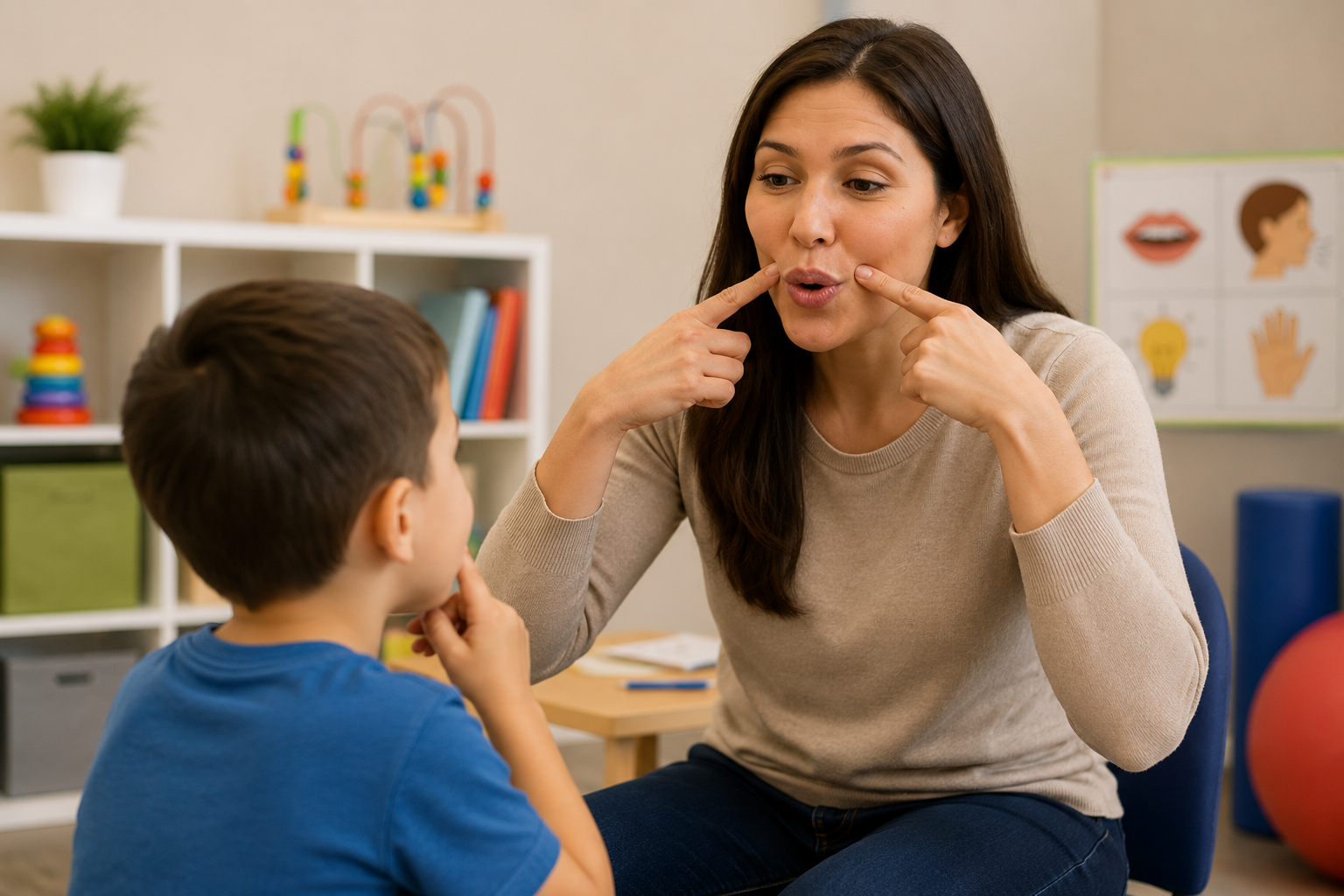
How Does Speech Therapy Help Children With Autism?
Speech therapy helps autistic children develop communication skills needed for daily life including using words, understanding language, making requests and interacting with people. Autism affects communication differently in every child. Some are non-verbal. Others have language but struggle to use it in social situations. Speech therapy works on whichever part of that picture is most affected for that specific child.
According to Dr. Sushant D. Sarang, Occupational Therapist in Navi Mumbai, “Communication in autism isn’t just about words. A child who can’t regulate their sensory system or process their environment is going to struggle to communicate regardless of how much speech work they do. That’s why OT and speech therapy work best together.”
How Does Speech Therapy Actually Work for Autistic Children?
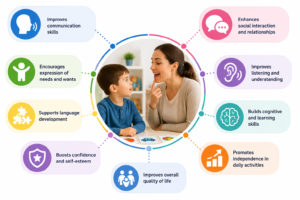
The approach depends entirely on where that child’s communication is breaking down. Two autistic children in the same session can be working on completely different things.
- Augmentative and Alternative Communication: For children who are non-verbal or have very limited speech AAC gives them a functional way to communicate before verbal language develops. This might be picture exchange systems, communication boards or speech-generating devices. The goal is giving the child a working communication channel right now rather than waiting for speech to arrive.
- Receptive Language: Understanding what other people say is a separate skill from producing speech and many autistic children struggle with it significantly. Following instructions, understanding questions, processing what a teacher just said — receptive language work addresses the comprehension side directly rather than focusing only on output.
- Social Communication: Having words is one thing. Knowing when to use them, how to start a conversation, how to take turns in an exchange, how to read what the other person is expecting — these are social communication skills and they’re often the main difficulty for autistic children who do have functional speech.
- Verbal Articulation and Fluency: Some autistic children have speech that is difficult for others to understand because of how sounds are formed or how words come out. Articulation therapy works on the physical mechanics of speech production so the child’s communication actually lands with the people around them.
Speech therapy works best when the assessment maps exactly where the breakdown is before sessions start because the work looks very different depending on the answer. For children where sensory processing is also affecting communication the blog on sensory integration therapy for autistic kids explains how SI and speech therapy address different parts of the same problem.
What Changes Do Families Actually Notice After Speech Therapy?
Progress in speech therapy for autism doesn’t follow a clean upward line. It stalls, jumps forward unexpectedly and sometimes looks like nothing is happening for weeks before something clicks.
- Requests Start Appearing: A child who used to melt down when they needed something starts pointing, handing over a picture card or using a device to communicate that need. The meltdown wasn’t defiance. It was a child with no other way to get information out. Once there is a channel the frequency drops noticeably.
- Following Instructions Gets Easier: A child who seemed to ignore everything said to them starts responding to simple instructions then two-step ones. This is receptive language developing and it changes classroom life significantly. Teachers notice it before parents do in most cases.
- Social Interaction Opens Up Slightly: A child who only spoke when spoken to directly starts initiating conversation in small ways. Or starts waiting for a response before continuing. These are tiny shifts that families track carefully because they know how much work sits behind each one. Play therapy alongside speech therapy helps build the social interaction side further for children who need structured support in that area.
- Frustration Reduces at Home: When a child can communicate even basic needs and feelings the daily meltdowns that come from being misunderstood start reducing. Not gone. But the household runs differently when the child has a reliable way to get information across.
Speech therapy for autism is a long-term commitment and families need to go in knowing that. Read more on what occupational therapy for children actually is.
Why Choose Tender Touch Therapy Clinic?
Dr. Sushant D. Sarang is a PhD Scholar in Occupational Therapy with Sensory Integration certification at Level I and IV from the USA and has been running T3 Clinic since 2007 across four Navi Mumbai locations with six specialist therapists working only with children.
Every child starts with a full individual assessment before sessions begin. Therapy is built around how that specific child is functioning right now and adjusted as things change. If something stops producing results it gets changed. Parents get specific updates on what was worked on and what shifted.
FREQUENTLY ASKED QUESTIONS
How long does speech therapy take to show results in autistic children?
Most autistic children need 6 to 12 months of consistent sessions before communication changes become stable.
Can speech therapy help a non-verbal autistic child?
Yes AAC-based speech therapy gives non-verbal children a functional communication channel before verbal speech develops.
Does speech therapy work alongside occupational therapy for autism?
Yes OT and speech therapy address different systems and produce better outcomes when running together.
What age should an autistic child start speech therapy?
Early intervention before age 5 produces the strongest outcomes though older children also respond well.
References
- American Speech-Language-Hearing Association — Autism Spectrum Disorder
- National Health Service UK — Speech and Language Therapy for Autism


